A learning curve gets better as you get better. A badly built job does not. How to tell which one you are in during your first 2 years as an NP.
You are 8 months into your first NP job. You still stay late most days, and you still feel slower than the NP down the hall.
Two different things can make your first years this hard. You are learning a new profession, which takes time. You may also be in a job that has no room for all the work. No amount of learning fixes that. From the inside, the two feel the same, and they need different responses.
A learning curve gets easier as you learn. A badly built job does not.
Is it normal to still be slow as a new NP?
Yes. Most new NPs work more slowly than experienced colleagues through much of the first year. You are seeing many presentations for the first time, learning your EHR, and learning how your clinic runs. Speed comes from familiarity, and familiarity takes time and repetition.
NP school taught you to diagnose and treat. It gave you much less practice running a full clinic day and handling the work each visit creates. I wrote about that gap in The NP Training Gap.
I was slow too. In my first 2 years, I charted every weekend and on most nights. I had administrative time on my schedule, and I used every minute of it. It still was not enough.
My charting speed was not the problem. I let visits start without an agenda, I let portal conversations run long, and I took on work that belonged to someone else. I had to learn how to work efficiently in my own clinic, and that took time.
Being slow in your first year is ordinary.
Is it normal to take work home in your first year as an NP?
Yes. Your first year is a learning year, and much of that learning happens off the clock. You research what you saw in clinic. You also chart, review results, and complete forms more slowly than you will later, because you are still learning how. Watch whether that take-home work shrinks over time.
The residents I precept this year tell me they want to fit all of their work inside a 40-hour schedule. I want that for them too. Their residency puts much more emphasis on work-life balance now, and I would like to think I had something to do with that.
The residents spend their scheduled hours seeing patients and attending didactics. Their patients bring up things the residents knew well enough to pass an exam but have not yet handled in practice. The residents go home and research those things. That off-the-clock homework is where they learn, and where the learning sticks.
First-year NPs outside a residency do the same homework. You take what you learned in school and learn to use it for the patient in front of you. Your employer did not cause that, and it does not mean you are clinically unprepared. It is what a career change asks of you, and moving from RN to NP is a career change, even after years at the bedside.
Charting works the same way. You are learning to work through your medical decision making and turn it into a note the next reader can follow. You are also learning to review results, respond to consult reports, and complete forms accurately, and how each one gets done in your clinic. A learner needs more time, and the clinic day rarely has that much room.
Taking work home in your first year does not, by itself, mean your job is badly built.
I also built something in my early years that I still use every day: a set of workflow tools. I built them over years, and I still revise them. When I showed my residents how to build their own, I made 4 or 5 improvements to mine in that one session.
Those tools are a big part of why I finish my work faster now than I did in my first 2 years. I did much of that work outside business hours. Ideally you put that time in early, because it is an investment in the NP you will be later. In your first years, it is normal for that work to happen off the clock.
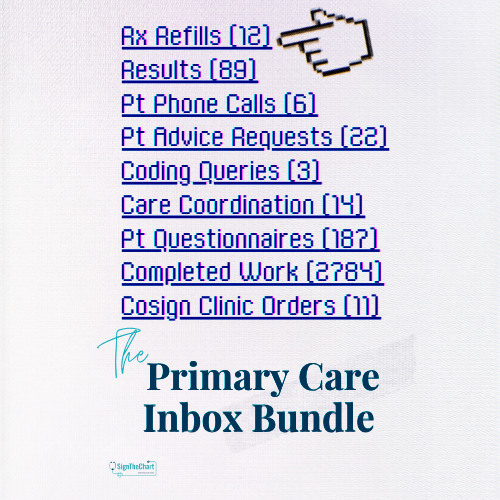
Start your tool library somewhere other than zero
The Primary Care Inbox Bundle gives you ready-to-paste templates for the portal messages, results, and refill requests you answer after the visit, plus the workflow around them. You install it once in any EHR that lets you save your own templates or dot phrases.
What should be getting easier as the months go by?
Less of your day should feel brand new. Common presentations become familiar, you close notes soon after the visit ends, and you need less homework at night. The pace depends on your specialty, your patients, and how your job was set up, so watch the direction of change rather than a date on the calendar.
If the work that overwhelmed you in month 3 still overwhelms you in month 18, pay attention to that.
Speed itself is a poor goal. The NPs who look fast have mostly made their work repeatable, which is why the same hypertension visit can take 5 minutes one day and 25 the next. I made a short video on why chasing speed does not fix the problem: Why "Getting Faster" Doesn't Fix NP Burnout.
In year 2 you will probably need less clinical homework. You still have to learn how to run a clinical schedule and handle the administrative work, and few NPs practiced either one in school. If you reach year 2 feeling clinically competent, you can make it the year you focus on workflow.
A few weeks into practice, you will not be on track to finish everything in 40 hours, and nobody should expect you to be. Learning takes time, experience, and exposure.
The question is not whether you are fast yet. It is whether anything is getting easier.
What is a ramp, and what should yours look like?
A ramp is how an employer brings any new NP hire onto a full schedule. You start with fewer patients per session and build to a full schedule over time. Your employer builds the ramp, so it is not the same thing as your learning curve. Experienced NPs starting a new job should get a ramp too.
Your learning curve belongs to you. The ramp belongs to the job.
My residency ramp ran 12 months. I started at 1 patient an hour and built to 3 an hour. When I joined the staff afterward, I still got a 6-month orientation, and the organization spread my ramp to a full schedule across those 6 months. They did that on purpose, because they wanted to keep their NPs.
That ramp did not make the first year easy. Months 6 through 9 were the hardest, because my visit volume went up and I finally understood how much I did not know. The ramp kept my schedule from adding to that load.
The ramp ends, but a well-built schedule keeps protecting you. Even at full volume, a well-built schedule keeps double-booking to a minimum and leaves space for walk-ins and for visits that run long because a patient needs more.
Your employer also decides your orientation. A 2015 study in The Journal for Nurse Practitioners found that formal orientation was the only factor that significantly predicted how well new NPs made the transition into the role. Years of prior RN experience did not.
Which parts of the workload never get easier with experience?
The parts that come from how the job was built. If your schedule has no administrative time protected from patients and meetings, if double-booking is routine, or if patient calls and messages reach you without triage, an experienced NP in your seat would stay late too. Skill does not shrink that work.
Every NP needs administrative time protected from patients and meetings, whether she is in her first year or her fifteenth, because every visit produces charting, results, messages, and forms. Without that time, you take the work home however experienced you are.
Your test results should come straight to you. You ordered the test, so you review the result. Nobody should stand between you and a result you ordered.
Patient phone calls and portal messages are different. Patients often ask you for something another department handles: a medical records request, the status of a referral or prior authorization, an appointment, or a billing question.
You should not see those messages at all. Each one belongs to staff whose job is to handle it. In a well-built clinic, someone triages patient calls and messages and routes them, so the only ones that reach your inbox need your decision or your input.
If your clinic has nobody in those roles, you end up doing their work yourself. If your clinic has the staff but nobody triages, every call and message lands in your inbox, and you sort and forward each one before you can do your own work. Either way, the job gives you more administrative work than your scheduled hours can hold, and getting faster will not change that.
I wrote more about which work can go to your team, and which has to stay with you, in The Work That Doesn't Require Your License Shouldn't Consume Your Time.
Picture the most efficient NP you have ever worked with, dropped into your exact schedule: your patient volume, your support staff, your administrative time, your inbox. Would she finish inside the day? If she would not, the job is part of why you stay late.
You can get faster at documentation. You cannot get faster at time that was never put on the schedule.
What does it look like when both happen at once?
Usually both happen in the same day, which makes them hard to separate. You can improve at everything that depends on your skill while you carry load that depends on how the job was built. When you sort the two, you know where your effort will pay off and where it never will.
The NP in this example is invented, not a real person.
She is 10 months into her first primary care job. She still researches a few patients most nights, and she still finishes some notes after clinic. Both happen less often than they did in month 2.
Her clinic also skipped her ramp. She went to a full schedule in her 3rd week, and she is double-booked most days. She has no administrative time protected from patients and meetings. Every patient message lands in her inbox, including referral status checks and billing questions that belong to other departments.
The research and the late notes are her learning curve, and they are shrinking. The schedule and the inbox come from how the job was built, and they will still be there in year 3.
When nobody separates the two, she blames herself for both.
Why does telling them apart matter so much?
Because they call for opposite responses. You can wait out a learning curve, and it will pay off. If you wait out a job design problem, you lose years, because the change you are waiting for is not coming. When you know which one you have, you can spend your effort where it returns something.
For your learning curve, give it time, and build the tools and habits that make your most common visits go faster.
For the job, find out what can change where you are. You can ask your manager for administrative time protected from patients and meetings. You can ask who is supposed to triage patient calls and messages, and whether requests about records, referrals, scheduling, and billing can go straight to those departments. Neither step requires you to leave.
Some things will not change where you are. Many NPs have solid reasons to stay in a job for now, and naming the problem does not push you toward the door. It stops you from spending years trying to outwork something that was never yours to fix.
Personal effort cannot fix a job design problem.

Find out which one you are dealing with
The Spillover Hours Audit is a free interactive tool built for this question. It shows you where your extra time goes, and whether the fix is your own workflow, the way the job is set up, or nothing at all, because one of its readings tells you your week is working.
Am I the only new NP who feels this far behind?
No. New NPs ask this constantly, often while looking composed from the outside. When you compare yourself to the colleague who leaves on time, you are missing most of the information: her years in practice, her patients, the tools she has built, and what she takes home without mentioning it.
The NPs a few years ahead of you remember this stage, and most of them will tell you so if you ask.
The colleague who leaves on time is not the measure of your first year.
Ask it where it is a normal question
Beyond the Chart is my free Facebook group for NPs working through the parts of the job school did not cover: the workload, the inbox, and what is fixable. Ask whether what you are seeing is normal, and hear from NPs a few years further along.
FAQ
What is the difference between a learning curve and a job design problem?
A learning curve is work that shrinks as your skill grows: research, charting, results, and forms all get faster with repetition. A job design problem is work that stays the same however skilled you get, because it comes from how the schedule, staffing, and message routing were set up. Only a change to the job changes it.
Do experienced NPs get a ramp when they start a new job?
They should. A ramp is for every new hire, whatever her experience. An experienced NP still has to learn a new EHR, new staff, new workflows, and a new patient panel. Starting with fewer patients per session and building to a full schedule gives her room to do that safely.
Should NPs have protected administrative time?
Yes, every NP, at every stage. Administrative time protected from both patients and meetings is the time you use to finish the charting, results, and messages each visit produces, inside your scheduled business hours. Without it, that work has nowhere to go but your evenings. Ask for it directly; you do not have to earn it first.
Should I leave my first NP job if it is not getting easier?
Not automatically. First, sort what belongs to your learning curve from what belongs to the job. Then find out which job problems can change where you are, such as administrative time or who triages patient calls and messages. Many NPs have solid reasons to stay. Knowing which problem you have keeps you from spending years trying to outwork it.
Related Reading
The Onboarding Question That Predicts Your First Year: what to ask about orientation and your ramp before you sign.
The Chaos of the Inbox: why the work after the visit has no time on the schedule, and what that costs you.
The Work That Doesn't Require Your License Shouldn't Consume Your Time: which work can go to your team, and which has to stay with you.