Last updated: 10/16/26
Your EHR Inbox Is a Second Job Nobody Put on Your Schedule
You finished your last patient at 4:45 PM.
You should be done.
Your inbox has 47 unread messages. 6 lab results. 3 refill requests. A consult report waiting on your acknowledgment. 2 portal messages from patients who want medication changes over text.
So you stay. Or you log in after dinner. Or you get up early and start clicking before the clinic opens.
None of that time is on the schedule. All of it is expected.
This is not a productivity problem.
It is a job that was built to need more hours than it gives you.
Why does the EHR inbox feel so overwhelming?
Because it generates continuous work with no time allocated to it, no decision rule attached to it, and no one assigned to it but you. The volume is not the hard part. The hard part is that every item arrives undifferentiated, and you are the one who has to sort it.
The inbox is not a feature in your EHR. It is a second job.
It collects everything that does not fit inside a visit. Lab results. Imaging reports. Prior authorization requests. Portal messages. Referral documents. Renewals. Insurance forms.
Each one asks for a different kind of thinking. Each one interrupts whatever you were doing.
And here is the part nobody says out loud at orientation: your employer almost certainly did not put protected time on your schedule for any of it.
You were given a patient panel and a visit schedule.
The rest was left for you to absorb.
That is not an oversight. It is how the job was designed, and the cost of that design lands on you.
Is your inbox problem really a time management problem?
No. Most of it comes from how the job was built, not from how you manage your day. A schedule booked edge to edge with visits, with no time protected from patients and from meetings for the work those visits create, produces after-hours work by default. Speed does not fix a design problem.
The usual advice is to work faster or be more efficient.
But you cannot out-type a workload that was never designed to fit inside the hours you are paid for.
If you are spending an hour or more a day in the inbox, and none of it sits inside your scheduled business hours, the arithmetic is not complicated. It is also not a character flaw.
It is a design issue, and the fix is a system, not willpower.
What does EHR inbox time cost a nurse practitioner?
Your salary pays for a role, not for a count of hours. When the hours go up and the salary does not, your real rate per hour drops. That is wage dilution. There is no overtime at hour 41 to recover it, because of how NPs are classified.
Nurse practitioners in primary care are usually exempt salaried employees. The salary covers the job regardless of how long the job takes.
Exempt status does not require you to work unlimited hours. What it does is remove the financial penalty an employer would otherwise face for building a job that routinely needs more than 40.
So the employer schedules a full day of billable visits, allocates nothing for the administrative work those visits produce, and keeps the revenue. You absorb the hours at home, at no additional cost to them.
That is a labor subsidy.
It is a transfer of value from you to your employer, built into the job design rather than incidental to it.
Do the math with your own numbers, not mine. Take your salary, divide by the hours you actually work, and compare it to the same figure at 40 hours.
I broke that calculation down in Stop Working a 60-Hour Job on a 40-Hour Salary.
Why does checking the inbox between patients make it worse?
Because every switch costs you re-entry time. You leave the note you were writing, read a message, decide nothing, and come back to a note you now have to reconstruct. Done 15 times across a clinic day, that time tax is larger than the inbox work itself.
This is the pattern that catches the most careful NPs.
Checking between patients feels responsible. It feels like staying on top of things. What it produces is a day with no uninterrupted block in it, and a stack of items you have looked at without resolving.
The alternative is handling the inbox in defined passes rather than continuously.
When you touch messages at set points instead of all day, you stop paying the re-entry tax on every single one.
Building those passes into a real clinic day is harder than it sounds, because the schedule fights you. That is the work the Primary Care Inbox Bundle does, and I come back to it at the end.
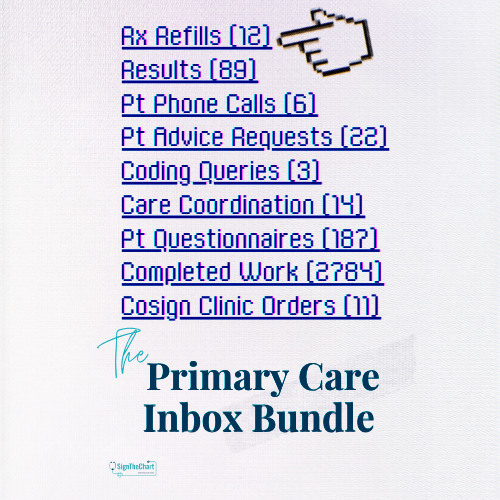
Your Path to Mastering the Inbox
51 ready-to-paste message templates plus the workflow around them, for the portal messages, results, and refill requests that arrive after the visit. Built so the inbox gets handled inside the hours you are scheduled to work, not after them.
Why do you keep opening the same message twice?
Because you have no rule that tells you what to do with it. Without a rule, every item becomes a fresh decision, and a decision you are not ready to make is a decision you defer. So you open it, look at it, and close it unchanged.
Every one of those partial touches spends attention and produces nothing.
The item is still there. You have paid for it twice and it is not done.
What changes this is deciding the categories once, in advance, instead of deciding message by message in the moment. A message you have already classified does not require fresh judgment at 7 PM.
The decision happens before the message arrives, or it happens 3 times.
Should you answer clinical questions through the patient portal?
No. A portal message asking you to evaluate a new symptom, change a medication, or interpret a result is asking for a visit. Answering it in full means practicing without an exam, generating medical decision-making with no encounter attached, and taking on the liability during time that is not on your schedule.
This is a boundary that protects you and the patient both.
Redirecting a clinical question to a scheduled visit is not dismissive. It is the clinically appropriate answer, and it is the one that gets the patient examined.
Your inbox is not a virtual visit. Treating it like one dilutes your pay and increases your exposure at the same time.
I went further on this in No, I Won't Prescribe That Through the Portal.
What creates most of the messages in an NP inbox?
A good number of them were created earlier that same day, in the last 2 minutes of a visit, when nobody said when the results would come back, how she would hear, or who calls about the referral.
Everything above is about what to do with a message after it arrives. There is an earlier point worth working on.
The patient left the room without the answer. So she sent a message to get it.
Say It Before They Leave is the words for that part. 20 end-of-visit templates, each one text to paste into the after-visit summary plus a line to say out loud before she walks out. 6 of them cover results and the waiting window.

Address the Concern Before It Hits Your Inbox
20 free end-of-visit templates. Each one is a script you say before the patient leaves and text you paste into her after-visit summary, so she goes home knowing what happens next.
What does a week with no protected inbox time look like?
The following NP is invented, not a real person.
She has 18 visits booked, no time protected from patients and from meetings, and a 15-minute slot length. She checks the inbox between patients because that is what she was told to do, and she leaves at 6:30 with 11 items still open.
She is not slow. She is handling every message as an individual decision, in the gaps between other work, with no rule to lean on and no time set aside for it.
Her evenings go to the leftovers. Her next morning starts behind.
Nothing about that week is a discipline problem.
It is a day with no container around the work the day produces.
When one inbox fix is not enough
One clear policy on results fixes one category. A primary care inbox has many more, and each one is capable of pulling clinical work off the schedule and into your evening.
The Primary Care Inbox Bundle is built for that. It gives you a triage protocol for deciding what each message needs, a batching system for when you handle it, and a library of message templates you can save in any EHR that lets you create and keep your own.
It is the same set of tools I use in my own practice, every clinic day.
You were trained to diagnose and treat. Nobody trained you to run the back half of the job.
That gap is where the hours live, and it closes with a system rather than with effort.
Questions NPs ask about inbox management
How do I handle my inbox when I am out of the office?
Decide the coverage arrangement before you leave, in writing, and tell your patients what to expect in the visits beforehand. An inbox with no named owner during PTO is not covered, it is paused, and the backlog is waiting when you return. This is a conversation with your employer, not a workflow fix.
Can AI scribes help with inbox management?
They help with documentation during the visit, which is a different problem. Inbox work needs clinical judgment for interpreting results, deciding what routes to staff, and communicating with patients. A scribe does not make those decisions for you.
Is it okay to set inbox boundaries with patients?
Yes. Redirecting a clinical question to a scheduled visit is standard practice. It protects diagnostic accuracy, gets the encounter documented and billed, and reduces your liability exposure.
What if my employer expects same-day responses to everything?
Then the expectation and the schedule are in conflict, and naming that is the first move. An employer who wants same-day turnaround has to put time on the schedule for it. Ask for the time protected from patients and from meetings, in writing.
Does any of this work if I cannot change my schedule?
Most of it does. Deciding your categories once, handling messages in passes, and routing what does not need your license are all inside your control. The schedule is the harder fight, and it is a separate one.
Related reading
Stop Calling Patients for Every Lab Result: which results need a call, and which ones were never a phone problem.
The Work That Doesn't Require Your License Shouldn't Consume Your Time: what routes to staff, and what has to stay with you.
Stop Working a 60-Hour Job on a 40-Hour Salary: the pay math behind all of this.