The NP Training Gap: Why New NPs Feel Unprepared for Practice
NP school prepared you clinically. The work around the visit, the money side, and writing the orders were rarely practiced. That is the NP training gap.
Last Updated: 10/18/2026
You passed your boards and earned your license. A few weeks into your first NP job, the visits run long, the inbox refills faster than you can clear it, and the notes are still open when you get home.
Then someone says, "You should know this by now."
You do know the medicine. What you were rarely given was practice at the rest of the job: the work that surrounds every visit, the money that runs the clinic, and the shift from carrying out orders to writing them. That is the NP training gap, and it is not a verdict on you.
Are new NPs prepared to practice when they graduate?
Yes, clinically. NPs graduate prepared to diagnose, treat, and practice safely, and the national NP organizations oppose any required residency. What school rarely gives you is practice running a full day: the work each visit creates, the business of the clinic, and the weight of being the one who decides.
That is not only my view. In 2019, the NP Roundtable (5 national organizations, including the AANP) stated that NPs are prepared to be fully licensed at graduation and that no post-licensure residency should be required.
So there are two kinds of readiness. Licensure readiness means you are safe to see patients. Running a full schedule at full speed, with a panel of patients who need things between visits, is a second skill set, and it was rarely on the syllabus.
The gap is in the job around the medicine, not in the medicine.
What does NP school leave out about the actual workday?
The second half of every visit. Refills, results, portal messages, prior authorizations, forms, and referrals arrive after the patient leaves, whether or not the schedule left room for them. During clinicals, someone else usually handled it, so most students rarely get to practice carrying that work and a full schedule together.
My own placement was in an internal medicine practice, and I saw that second half up close. I arrived an hour before the physician each day and cleared his pending labs and refill requests before he walked in.
Over the semester I worked down a backlog that predated me and kept a new one from forming. I am grateful for that experience, and he is not the villain here. He was carrying the same flood many primary care physicians carry.
What I was practicing was his administrative work, not how to manage my own alongside a full schedule. When he said I needed to be faster, there was no guidance attached about what to start doing, stop doing, or do differently.
The gap showed up when I started practicing on my own. Nobody arrived early to clear my inbox. I took on the clinical load and the administrative load at the same time, with no model for doing both inside the same day.
I talk through why that second half lands on your evenings in Why NP Jobs Eat Your Evenings, and Administrative Chaos maps the work itself.
Clinicals showed you the visit. Nobody scheduled practice for what comes after it.
Why do visits run long when you already know the medicine?
Because the gap is speed under complexity, not knowledge. School taught one patient and one complaint with time to think. Practice hands you several problems in one short visit while you chart, order, and decide what waits. Speed comes from preparation and from structure decided before the visit, not from typing faster.
Picture an invented patient: a 58-year-old with diabetes, high blood pressure, depression, knee pain, and a new rash, booked for 15 minutes. She mentions 2 more concerns after you start the exam. Nothing about her is beyond your training. All of it has to fit in the slot.
In my first 2 years, I charted on more than one day off. I did have administrative time, and I used every minute of it. It still was not enough, because the things eating my day were not documentation problems.
They were visits that arrived without an agenda, portal conversations I let run long, and work I absorbed that should have been delegated or declined. What I had to learn was communication, workflow, and deciding what I would and would not stop a visit for. None of it was clinical.
Why the Same Hypertension Visit Takes 5 Minutes One Day and 25 the Next shows how much of visit time is decided before you walk into the room.
The visits that come back to your schedule every few months are where this pays off most. If the structure for those notes is already built, you spend the visit on the patient instead of deciding how to document the same visit from scratch.

STOP BUILDING THE SAME CHRONIC DISEASE NOTE FROM SCRATCH
Done-for-you SOAP note templates for the chronic disease visits that return to your schedule every few months. Save them once in any EHR that lets you create your own templates or dot phrases, then reword them until they sound like you.
Knowing the medicine and moving through a full schedule are two different skills.
Why does the move from RN to NP feel so disorienting?
Because you went from carrying out orders to writing them. As an RN you checked an order against someone else's reasoning. As an NP you supply the reasoning, and everyone downstream checks against it. Research on new NPs has described this shift, from expert to novice, as stressful for decades.
A 2021 study in the Journal of the American Association of Nurse Practitioners (Barnes, Faraz Covelli, and Rubright) summarizes 2 decades of that research. It found the move from expert RN to novice NP often lowers confidence and job satisfaction and raises the intent to leave a first position.
As an RN, learning by watching experienced nurses made sense, because someone upstream had already supplied the rationale. As an NP, nobody upstream supplies it anymore. Copying your preceptor's habits is not wrong. It is no longer enough, which "Just Getting a Baseline" Is Not a Clinical Reason works through using lab orders.
The identity side of this, going from the nurse everyone asked to the NP who second-guesses every plan, is its own subject. Imposter Syndrome and the NP Transition covers it.
Feeling like a beginner again is part of changing roles, not proof you chose wrong.
Why did nobody explain the business side of the job?
Because NP school prepares you clinically and gives you almost nothing on the business side, in coursework or in clinicals. As an RN you never had to think about revenue, and many of us were proud of that. As an NP you carry an NPI number, you bill, and your documentation decides what the clinic is paid.
That inversion explains a lot about the first year. In primary care, the visit is what generates revenue. The refills, results, and messages each visit creates do not, and many schedules are built to fund only the first.
Most primary care NPs are exempt salaried employees, which means the salary covers the role, not a set number of hours, and there is no overtime at hour 41. When the work around the visits runs past your scheduled business hours (the hours the schedule was actually built around), those extra hours cost your employer nothing.
They cost you. Your salary stretches over more hours, and your real hourly rate drops. Here those hours have a name: spillover hours, the work that follows you home because the schedule was never built to hold it.
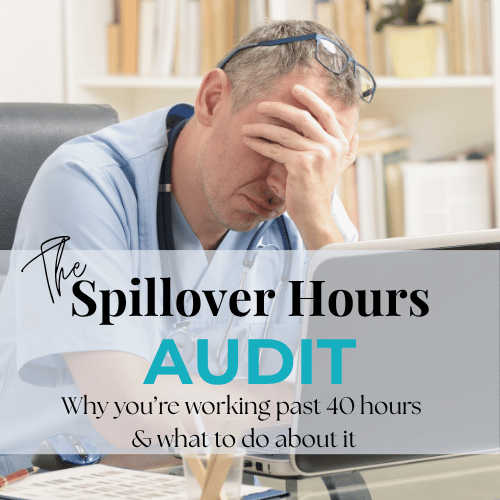
WHERE DOES YOUR EXTRA TIME ACTUALLY GO?
The Spillover Hours Audit is a free tool you fill in with your own week. It shows where the time past your schedule lands and whether the fix is your workflow, the way the job is set up, or nothing at all, because your week may already work.
The visit pays for itself. The work it creates is the part nobody budgeted.
Is the NP training gap your fault?
No. Part of the gap is skill you can still build: communication, workflow, and how you structure the visit. Part of it is how the job is set up: onboarding, support staff, and how full the schedule is. The first part closes with practice. The second part does not close by working harder.
Onboarding is where the two meet. NP programs tend to assume employers will provide mentorship and a gradual start. Many employers assume a licensed, certified NP can carry a full schedule right away. When both assume the other side has it covered, the new NP lands in between.
If you are choosing a first job, onboarding is worth asking about directly, and The Onboarding Question That Predicts Your First Year covers what the answer tells you. Stop Taking 'Any NP Job' to Gain Experience explains why the first role sets the pattern for the ones after it.
If you are already in the job, and most readers are, the skill half of the gap closes where you are. The work around the visit can be learned in the job you have.
You were trained for the medicine. The rest of the job is learnable, and it was never yours to know on day one.
Frequently asked questions about the NP training gap
Is NP education inadequate?
No. NP education produces clinically prepared, certified NPs, and the national NP organizations hold that new graduates are ready for licensure. The gap is in practice running a full day: the administrative work each visit creates, the business side of the clinic, and the shift from carrying out orders to writing them.
Is the training gap the same as imposter syndrome?
They are related but not the same. The training gap is missing practice in parts of the job school did not cover. Imposter syndrome is the self-doubt that gap often triggers. Mentorship helps with the doubt, but the gap itself closes only by learning the skills that were never taught.
Can a residency or fellowship close the training gap?
It can close parts of it. Post-graduate NP fellowships are optional, not required for licensure, and the NP Roundtable describes them as orientation to one employer's setting. One closes the workflow and business side of the gap only if it explicitly teaches the work around the visit. A first job with real onboarding and mentorship can do the same.
Does the training gap mean I am slow?
No. Running long in your first year usually reflects visits that arrive without structure, administrative work that was rarely practiced, and a schedule that may not hold it. Those are learnable skills and job design questions, not a measure of your clinical ability or how fast you think.
Related Reading
Administrative Chaos: The Invisible Work: the work each visit creates, and why it ends up in your evenings.
The Lie of the Default EHR: why the EHR slows you down at a new job, and what tailoring it changes.
The Onboarding Question That Predicts Your First Year: what to ask before you sign, so the gap does not land on you unsupported.