

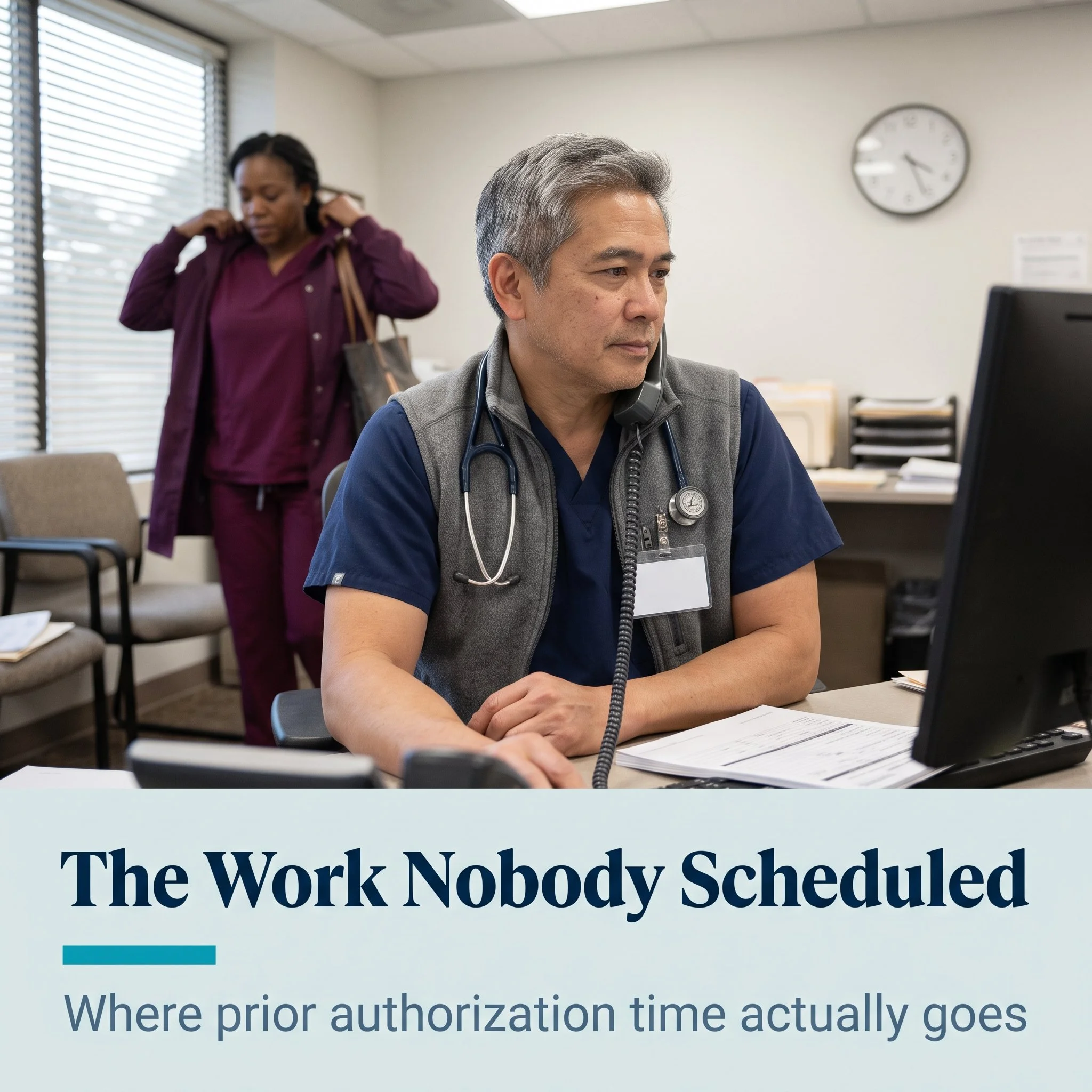
Prior Authorization: The Work Nobody Put on Your Schedule
Prior authorization work has no slot on a primary care schedule. Where the time goes, which parts need your license, and what it does to your pay.
A prior authorization is not a clinical task. It is a clerical task with clinical consequences, and it lands on the person with the least open time in the building.
You already made the decision. You know why the patient needs the medication. Now someone who has never met her needs it in writing, in their format, inside a window you did not set.
None of that was on your schedule this morning, and none of it will be on your schedule tomorrow.
You are not slow at prior authorizations. Nobody set aside time for them.

Why the Same Hypertension Visit Takes 5 Minutes One Day and 25 the Next
Charting time swings from 5 minutes to 25 on the same hypertension visit. Why it happens to NPs, and why typing faster is not the fix.
You finish a hypertension follow-up in 5 minutes flat. Later that same day, another one, same diagnosis, same stable patient at goal, takes 25.
It is easy to read that as a focus problem, or a you-were-tired problem, or proof that you are just slow at charting. It is none of those.
The swing is real and it has a cause. What changes between those two visits is not your speed. It is how much of the thinking was already done before the patient sat down.
Charting speed is mostly preparation. It is almost never typing.

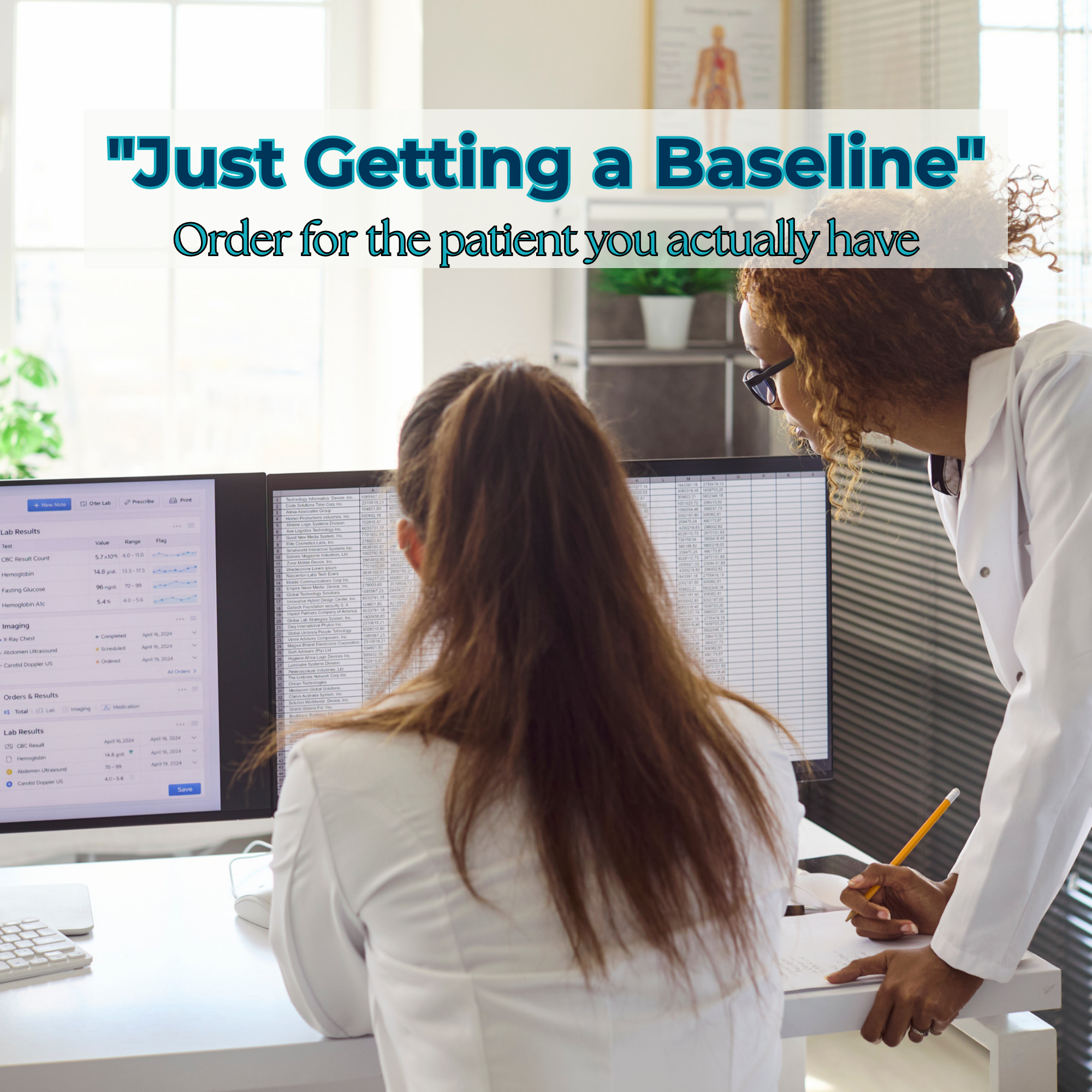
"Just Getting a Baseline" Is Not a Clinical Reason
A new NP hands you her draft orders for a healthy new patient. CBC, CMP, TSH, lipid panel, maybe an EKG.
You ask what one of them is for. She says she is getting a baseline.
She is not being careless. She has watched experienced NPs and physicians order exactly this on nearly every adult who walks in, and nobody has ever told her why. The list gets passed down. The reasoning does not.

The Onboarding Question That Predicts Your First Year
The most important moment in your interview is not a question you answer. It is how they handle one you ask.
You ask what onboarding looks like. The hiring manager nods, and then pivots to how quickly you will need to learn their charting system.
That pivot is the answer.
This post gives you the single question that predicts whether your first year is a foundation or a trap, and how to read the response, including the most common way employers dodge it.
Ask what onboarding looks like for a new NP in the first 90 days. The specifics, or the absence of them, tell you almost everything.


Know Your Number: The Hourly Rate to Set Before You Sign
Most NPs walk into a job offer asking the wrong question. Is this a good salary? What does the market pay around here?
Neither of those tells you whether you can actually say yes to this job.
The number that protects you is the one almost no one calculates: the lowest rate you can accept before the job starts costing you more than it pays. Call it your number.
This post shows you how to find that number, and how to test any offer against the hours you will really work, so you can tell when a salary that looks fine is a pay cut wearing a nice outfit.
Your number is the rate you need. The market rate is the rate other people accepted.
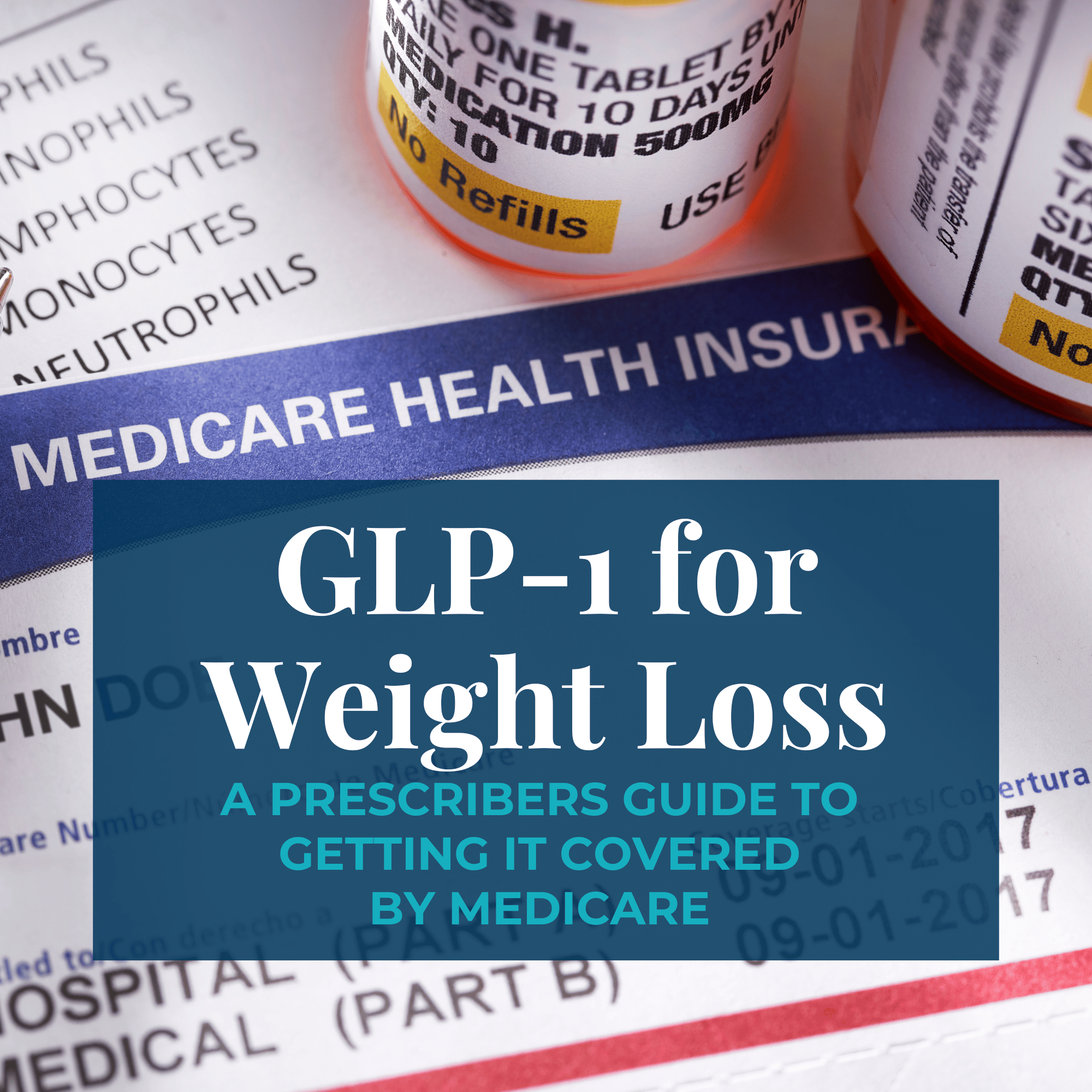
The Medicare GLP-1 Bridge: Three Reasons Prior Authorizations Get Denied
Your patient has been asking about Wegovy for two years. She is on Medicare, she does not have diabetes, and every previous conversation ended the same way. Then on July 1, 2026, that changed.
The Medicare GLP-1 Bridge opened a coverage pathway for GLP-1 medications prescribed for weight management. It is a real pathway with a $50 monthly copay, and it runs through December 31, 2027.
It also has criteria specific enough that a thorough, well-written note can still produce a denied request. Three things account for most preventable denials, and all three are avoidable if you know about them before you send the prescription. This article covers what the program is, who qualifies, and those three failure points, so your first submission is your only submission.

I Don't Do It All: The NP, Working Mother, and the Myth of Handling Everything
There is a question that shows up in every NP group, usually from someone who is one bad week away from quitting. How do you do it all?
I want to answer it plainly, because the real answer is the thing that changed how I work.
I don't do it all. I made peace with that a long time ago.
If you are a nurse practitioner and a mother and you feel like you are failing at both, read on. Not because you need to try harder. Because the thing you have been trying to do was never actually possible, and no one said so out loud.
The work that follows you home is not proof that you are behind. It is proof that the job was built to need more hours than it pays for, and you have been covering the gap at your kitchen table after the kids go to bed.

The Work That Doesn't Require Your License Shouldn't Consume Your Time
In a well-functioning primary care practice, your clinical time is the most expensive resource in the building. Your employer knows this. The billing model is built around it. Every patient interaction that generates revenue is centered on your presence, your judgment, your license.
Which makes it particularly strange that so much of the work in a primary care day doesn't require any of those things.
Calling a patient to confirm their appointment. Collecting routine screening questionnaires. Looking up a previous lab value that's already in the chart. Confirming that a medication is on a patient's current list. Tracking down a referral that should have been sent three weeks ago.
None of that requires a clinical license. All of it is, in many practices, consuming clinical time.
This is not a time management issue. It is a structural design issue. And it is one of the most reliable contributors to the work-overflow problem.

Real-Time Documentation: Why the Note Belongs in the Room
The after-shift charting problem is usually described as a documentation problem. It isn't, not exactly. It's a timing problem.
The note is hard to finish at 9 PM because 9 PM is the wrong time to be finishing it. The visit happened at 2 PM. By 9 PM, the specific details (what the patient said, what you found, what you were thinking when you made the decisions you made) have faded. The note you write at 9 PM is a reconstruction, not a record.
Real-time documentation is the practice of building the note during the visit, while the patient is in the room and the clinical encounter is still live. It is the most direct solution to the after-shift charting backlog, and it is a skill that NP training does not teach.

Why a Good Template Outperforms Your Best Effort Every Time
Every time you open a blank SOAP note and start writing from scratch, you are making a decision about how to structure this note, what to include, how to phrase the assessment, what elements the plan needs to contain.
Some of those decisions are clinical. They should be.
Many of them are not. They're structural, and rebuilding structure from scratch every single visit is invisible work that consumes time, cognitive load, and attention that your patient visit should be claiming.
A well-built template makes those structural decisions once. Then it implements them consistently, automatically, for every patient.
That's not laziness. That's the operational logic behind every reliable professional system.

What "Other Duties as Assigned" Is Actually Costing You
Somewhere in your employment contract, there is a clause that reads something like this: "The employee agrees to perform other duties as assigned by the employer."
Four words. Unlimited reach.
Most NPs sign this clause without much thought. It reads like standard boilerplate. It probably is standard boilerplate. What "standard" means in this context is that it appears in most NP employment contracts. Not that it's acceptable, or that it protects you, or that it means the same thing in practice as it sounds like it means on paper.
This clause is the mechanism by which every future scope expansion, added responsibility, and retroactive policy change becomes contractually permissible. Understanding it changes how you read everything else in your contract.

What Job Creep Is Actually Costing You Per Hour
Your salary looks the same as it did three years ago. Your job does not.
Most experienced NPs know this. They feel it in the length of their workday, in the responsibilities that have quietly accumulated, in the preceptee they're supervising while simultaneously managing a full patient schedule. What they often can't do is put a number on it.
That's the problem. Vague dissatisfaction is easy for an employer to acknowledge and ignore. A specific number is harder to argue with.
This article is about the number. How to calculate it, what it tells you, and how to use it to open a compensation conversation that is grounded in data rather than frustration.
Urgent Care as a First NP Job: What to Weigh Before You Decide
Urgent care comes up constantly in conversations about first NP jobs. The appeal is real and worth taking seriously before you dismiss it or accept it without thinking.
The shift structure is clean. You clock in, see patients, and clock out. There's no patient panel to manage across months, no inbox messages building up while you sleep, no longitudinal relationship with patients whose chronic disease management requires sustained cognitive attention across years. For a new graduate who is still calibrating the pace and pressure of independent practice, that kind of structural clarity has genuine value.
But the question "should I do urgent care?" is the wrong frame. The right frame is: what does this specific urgent care job actually look like, and is it designed for me to grow in?

Your Chart Is the Record. Does It Show Your Reasoning?
I was precepting an NP resident whose patient's kidney function had worsened. Several medications had to stop or change, and we spent most of the visit working through each one and explaining every change to the patient.
Her clinical work was right. When I read her note a few days later, it listed which medications were stopped and which were changed. It did not say why, or whether the patient understood.
Good NP documentation answers one question for anyone who reads the note later: what did you decide, and why? The resident's note recorded what she did and left out why. That gap has nothing to do with length, and it matters at every point where someone depends on the record: when a patient declines the plan, when she goes home with instructions, when new information arrives, and when the visit is billed.

High Patient Volume Doesn't Just Exhaust You. It Cuts Your Hourly Rate.
Twenty-three patients in 15-minute slots. That is the schedule. That is what's on the books when you walk in the door.
What isn't on the books: the inbox, the labs, the portal messages, the refill requests, the prior authorizations, and the documentation you're still finishing at 7 PM.
High patient volume gets talked about as an exhaustion problem. It is also a math problem. And when you do the math, the number that comes out on the other side isn't just a measure of how tired you are. It's a measure of how much of your labor is consuming personal time that your salary was never designed to cover.

Stop the Guilt: Leaving on Time Is Part of the Job
The culture of medicine often equates self-sacrifice with clinical virtue. You are told, implicitly and explicitly, that long hours prove dedication. That sacrificing your health, your family time, and your hobbies makes you a better clinician. That leaving on time means you do not care enough.
But cognitive overload and chronic exhaustion do not produce excellent care. They produce errors, poor judgment, and burnout. The provider who is well-rested, mentally present, and has a protected personal life is not cutting corners. That provider is a safer clinician.

The 3-Year Creep: Why Experienced NPs Are the Biggest Targets for Unpaid Labor
This is about the quieter, slower version of exploitation that targets experienced NPs specifically. The kind that accelerates after year three. The kind that feels like recognition but functions as extraction.
You are not being overworked because you are failing. You are being overworked because you are good at this. And your employer knows it.