

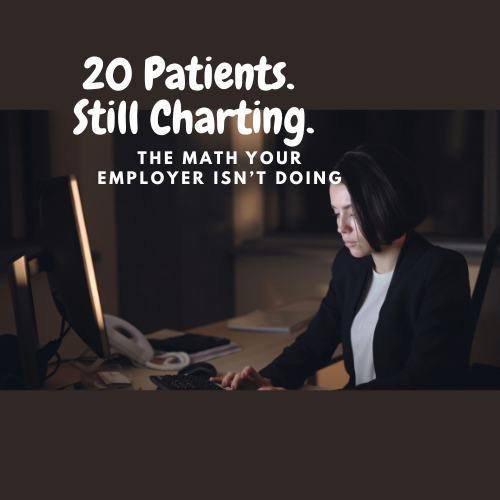
High Patient Volume Doesn't Just Exhaust You. It Cuts Your Hourly Rate.
Twenty-three patients in 15-minute slots. That is the schedule. That is what's on the books when you walk in the door.
What isn't on the books: the inbox, the labs, the portal messages, the refill requests, the prior authorizations, and the documentation you're still finishing at 7 PM.
High patient volume gets talked about as an exhaustion problem. It is also a math problem. And when you do the math, the number that comes out on the other side isn't just a measure of how tired you are. It's a measure of how much of your labor is consuming personal time that your salary was never designed to cover.

The Ultimate Guide to Escaping the NP Overwork Trap
If you are a primary care NP working 50 to 60 hours on a 40-hour salary, the first thing you need to hear is this: the problem is not you. The problem is that you were trained to diagnose and treat but never trained to manage the operational reality of independent practice. No one taught you how to build documentation systems, manage an inbox, contain a visit, delegate non-provider tasks, or protect your compensated hours from the constant creep of unpaid labor.
That gap between what school taught and what the job actually requires is where the overwork lives.

Delegation Is Not About Hierarchy; It's About Survival.
Do you ever feel like you alone are responsible for every single task, every detail, every day?
It’s the pervasive belief that "If I don't do it, it won't get done right". This belief, though well-intentioned, is a direct pipeline to unpaid after-hours work and burnout. When you try to do everything yourself, you ensure your time is consumed by non-provider tasks, forcing your licensed, high-value work into your personal time.
It's time for a critical mindset shift: Delegation is a core leadership skill that protects your 40-hour workweek.

FAQ: Chart Smart Mastery
Answers to Your Toughest Questions About Primary Care Workload Management
You are working 50 to 60 hours on a 40-hour salary. Your inbox follows you home. Your notes bleed into your evenings. And the advice you keep hearing (“practice self-care,” “set boundaries,” “learn to say no”) does not address the actual structural problem.
You were taught to diagnose and treat. You were never taught the day-to-day operational skills required to complete primary care work inside paid hours. That is not a personal failing. It is a training gap. And it is the reason you are here.
Below are the most frequently asked questions about Chart Smart Mastery and how it helps primary care NPs stop diluting their salary with free labor.

The Secret to Finishing Your Work on Time? It's Your Order Sets.
Your last patient left 45 minutes ago. You are still clicking through labs, imaging orders, and referrals, one by one, rebuilding the same hypertension workup you built three times already today. That repetitive clicking is not clinical care. It is invisible work that no one is paying you for.
There is a way to turn that entire process into a single action. It is called an EHR order set, and it is one of the most underused time protection strategies in primary care.

Beyond Billing: Why a Thorough H&P Protects You, Your Patients, and Your Practice
If you have ever opened a chart before a visit and found vague notes, an outdated medication list, and no clear record of which active problems were actually being managed, you already know what poor documentation costs. You had to start from scratch. You had to guess. You spent your limited visit time doing archaeology instead of medicine.
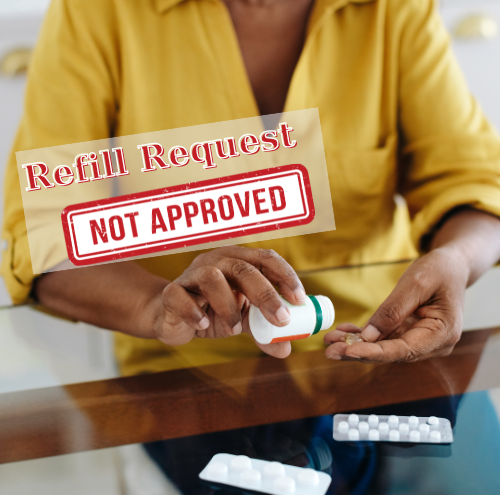
When Refill Requests Need a Second Look
That single refill request just consumed 10 minutes. You have 14 more waiting.
This is the part of medication management that no one tracks and no one pays you for. It is invisible work that no one is compensating you for, and it is one of the highest-volume sources of after-hours labor in primary care.

The Pre-Charting Advantage
Pre-charting is a core tactical strategy for highly efficient primary care providers. It is a proactive approach to ensuring accuracy and efficiency in every patient encounter, and it keeps you from making up lost time later during your personal hours. By dedicating a few focused minutes to preparation, you can turn a chaotic visit into a structured, goal-oriented one.