The Work That Doesn't Require Your License Shouldn't Consume Your Time
In a well-functioning primary care practice, your clinical time is the most expensive resource in the building. Your employer knows this. The billing model is built around it. Every patient interaction that generates revenue is centered on your presence, your judgment, your license.
Which makes it particularly strange that so much of the work in a primary care day doesn't require any of those things.
Calling a patient to confirm their appointment. Collecting routine screening questionnaires. Looking up a previous lab value that's already in the chart. Confirming that a medication is on a patient's current list. Tracking down a referral that should have been sent three weeks ago.
None of that requires a clinical license. All of it is, in many practices, consuming clinical time.
This is not a time management issue. It is a job design issue. And it is one of the most reliable contributors to the work-overflow problem.
Why Delegation Breaks Down in Primary Care
The most common explanation for why NPs do work below their license is "it's faster if I just do it myself." And in the immediate term, it often is. It takes less time to look up the lab yourself than to stop, identify the right person, explain what you need, and wait for them to retrieve it.
That calculus is correct for a single task. It is wrong across an entire day.
But individual habit is only part of the story. Delegation also breaks down for structural reasons that have nothing to do with NP preference: support teams that are understaffed and already at capacity; workflows that were never designed to route non-clinical tasks away from the NP; liability concerns that make NPs hesitant to hand off anything adjacent to clinical judgment; and the supervision time cost, the time it takes to communicate the delegation clearly, that feels prohibitive when you're already behind.
Fixing delegation requires addressing both the habit and the structure. The habit shifts when you see the math across a full day. The structure shifts when the workflow is redesigned to route non-clinical tasks to the right people by default, not by individual request.
What Delegation Is and What It Isn't
Delegation is not about hierarchy. It's not about authority or status or making clear who's in charge. Those framings make delegation feel uncomfortable, which is part of why NPs avoid it.
Delegation is about matching the work to the person who can appropriately do it. In primary care, that means identifying which tasks require your clinical license and which don't, then routing non-clinical tasks to the team members whose roles exist to handle them.
The medical assistant whose role includes gathering patient history, administering screening tools, and preparing the patient for the visit is not being burdened when you ask them to complete those functions before you enter the room. That is the job. The job exists to support the visit structure. When it's working, the visit is more efficient for everyone, including the patient.
Delegation fails when it's unclear, inconsistent, or treated as optional. It works when it's built into the workflow as a standing structure. Not a request you have to make each time, but a system that operates without requiring your management on every cycle.
The Underlying Test
The question that applies to every task you're doing: does completing this require my clinical license and judgment?
If the answer is yes (differential diagnosis, treatment planning, complex patient communication, medication decisions), that work belongs to you. If the answer is no (routine data collection, screening administration, record retrieval, patient outreach, referral tracking), that work belongs somewhere else in the team structure.
In a well-designed primary care practice, the work that doesn't require a clinical license is flowing toward the people whose roles are built to handle it. MAs are handling preparation and routine data collection. Nursing staff are handling patient education and triage calls with standardized protocols. Administrative staff are handling outreach and coordination. The NP is handling clinical work.
Practices that have built this structure describe a consistent outcome: NPs finish their clinical work during the workday because the non-clinical work isn't competing for the same time.
The Pre-Charting Delegation Trigger
The most practical delegation habit in a high-volume primary care day connects directly to pre-charting. In the few minutes before each visit (while you're reviewing the chart and orienting to the clinical priorities), you can also identify what needs to be done before you enter the room and communicate it to your support staff.
That communication doesn't have to be complicated. It needs to be specific and consistent. Practices that have built this into the workflow describe a consistent pattern: the NP arrives in the room with the preparation already done, because the system routed the preparation work to the right person before the visit started.
The initial investment is in building that expectation clearly enough that it runs without requiring your direct management every cycle. Once it's built, it holds.
The Structural Argument for Delegation
Here is the argument made plainly: every non-clinical task you perform personally is a clinical task you deferred. The deferral doesn't make the clinical task go away. It means the clinical task (the documentation, the result review, the inbox management) happens in your personal time instead of your scheduled clinical time.
Because you are a salaried exempt employee, the employer bears no additional cost for that personal time. You absorb the entire cost of the deferral. The practice captures the revenue from the clinical work you did during the day. You personally fund the hours it took to finish the non-clinical work after it ended.
Delegation isn't about comfort or preference. It's about keeping your highest-cost resource (your licensed clinical time) doing the work it's actually for. And keeping the work that follows you home inside the building where it belongs.
If you want to go deeper on building the full workflow infrastructure that keeps primary care work inside a 40-hour week, including delegation systems, inbox management, pre-charting, and real-time documentation, the NP Workflow & Survival Guide gives you the framework.
The inbox is where the most delegable work piles up: lab results, consult reports, portal messages, refill requests, forms, and care coordination tasks that all land in one place and all demand a decision. Sorting what you answer, what you schedule, and what you hand to a staff member is delegation in its most concrete daily form.
The Primary Care Inbox Bundle is the system for making those calls in seconds and keeping the inbox inside business hours. It includes a triage protocol with a staff routing reference and ready-to-use delegation scripts, a batching workflow that protects inbox time during the workday, and fifty patient-facing message templates that install once in any EHR.
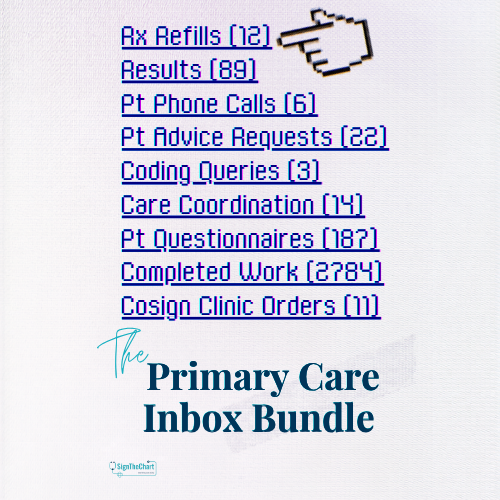
The Primary Care Inbox Bundle: a triage protocol, a batching workflow, and fifty message templates for deciding in seconds what you answer, what you schedule, and what you hand to staff. Click through to see what's inside.