Real-Time Documentation: The NP Skill That Eliminates After-Shift Charting
The after-shift charting problem is usually described as a documentation problem. It isn't, not exactly. It's a timing problem.
The note is hard to finish at 9 PM because 9 PM is the wrong time to be finishing it. The visit happened at 2 PM. By 9 PM, the specific details (what the patient said, what you found, what you were thinking when you made the decisions you made) have faded. The note you write at 9 PM is a reconstruction, not a record.
Real-time documentation is the practice of building the note during the visit, while the patient is in the room and the clinical encounter is still live. It is the most direct solution to the after-shift charting backlog, and it is a skill that NP training does not teach.
Why Real-Time Documentation Feels Impossible (And Why It Isn't)
The objection to real-time documentation is that typing while a patient is talking is rude, that it breaks the clinical relationship, that patients notice and feel dismissed.
This is true of documentation done carelessly. It isn't true of the practice done well.
Done carelessly: the NP stares at the screen, types continuously, and the patient feels like they're talking to a keyboard.
Done well: the NP maintains eye contact for the narrative portions of the visit, uses natural pauses in the conversation to enter data, and briefly acknowledges what they're doing when it's useful to do so. The patient sees an NP who is thorough, not distracted.
The skill is in matching documentation to the natural rhythm of the visit. Not typing through the conversation, but using the spaces that already exist in every clinical encounter. Those spaces are real. They're built into the visit structure. NPs who use them consistently report finishing their notes before they leave the building.
The Pre-Charting Setup That Makes Real-Time Possible
Real-time documentation doesn't start when the patient walks in. It starts in the minutes before.
Pre-charting is the practice of preparing for the visit before the patient enters: reviewing the chart, orienting to the clinical priorities, and setting up the note structure so that when the patient arrives, you're adding specific information to an existing framework rather than building everything from scratch under time pressure.
The difference is significant. A note built on a structure you prepared before the visit is more complete and more accurate than one you reconstructed after the fact. The clinical reasoning is fresher. The patient-specific details are captured in the moment rather than approximated later. And the visit itself moves more efficiently because the cognitive work of orientation happened before the clock started.
NPs who combine pre-charting with real-time documentation consistently describe the same outcome: the note is substantially complete when the patient leaves the room. There is no backlog at the end of the day.
What Changes When the Note Is Done in the Room
The most immediate change is the obvious one: no pile at end of day. The notes are done. You leave.
The second change is less obvious: the notes are better. Not longer. Better. The clinical reasoning is more accurate because you're documenting it at the moment of decision, not reconstructing it four hours later. The patient education language is more specific because you're capturing it from the conversation you just had.
The third change is the structural one. When documentation stays inside the workday, the math of your compensation changes.
Here is what that means. Your salary was calculated against a 40-hour week. Every hour you work beyond that 40 dilutes what that salary is actually worth per hour, because the same fixed amount is now covering more time. Most NPs are classified as exempt salaried employees, which means there is no overtime mechanism to compensate for those extra hours. The employer bears no financial penalty for the overage. You absorb the entire cost of it in personal time.
This is not accidental. A schedule packed with billable patient visits and no protected time for the documentation, inbox work, and administrative tasks those visits generate is a schedule that depends on you completing the non-billable work somewhere. That somewhere is almost always after hours. The employer captures the revenue from the visits. You absorb the cost of everything the visits produced that wasn't billable. Because you're exempt, that arrangement costs the employer nothing additional. It costs you your evening.
When your notes are done before you leave the building, that arrangement ends. The work fits inside the hours your salary was designed to cover. The employer no longer benefits from hours they aren't scheduling or paying extra for.
And you have your evening back.
That is what a workday with a real endpoint looks like. The day ends. The work ends with it.
Why This Is a Skill Gap, Not a Speed Problem
Most NPs who struggle with after-shift charting assume the problem is that they're slow. They're not, usually. The problem is that they were never taught to build documentation during the visit.
NP training teaches clinical reasoning: diagnosis, treatment planning, patient communication. It does not teach documentation workflow. The result is that most new NPs arrive in practice with sophisticated clinical skills and no operational framework for when and how the note gets built.
They default to the approach that feels safest: finish the visit first, chart after. That approach works adequately when visit volume is low and time pressure is moderate. At 20 patients a day in 15-minute slots, it doesn't work. The backlog is structural, not personal.
Real-time documentation with pre-charting is the operational skill that closes that gap. It's teachable, it requires practice to build, and the NPs who build it describe the before-and-after clearly: the workday now has an end.
The NP Workflow & Survival Guide introduces the pre-charting and real-time documentation approach, including how the two practices work together and what the transition period looks like.
Building the Practice
Real-time documentation is a skill. Like pre-charting, like agenda-setting, like delegation, it requires practice before it becomes automatic. The first week of attempting it will feel slow. The second week will feel workable. By the fourth week, the alternative (saving notes for later) will feel worse, because you'll have experienced what it's like to leave without them.
The investment is calibrated time at the beginning. The return is every evening you don't spend at the kitchen table finishing charts.
Real-time documentation gets easier when the structure is already built before the visit starts. Chronic disease is where that pays off most, because the same conditions come back through your schedule week after week with the same note structure.
The Chronic Disease Chart Smart Kit Bundle gives you the SOAP building blocks for the seven conditions that fill a primary care panel (hypertension, diabetes and prediabetes, hyperlipidemia, asthma, COPD, anxiety, and depression), each one ready to paste into your EHR's text-expansion tool and anchored to current clinical guidelines. With the blocks already built, real-time documentation becomes a matter of dropping them in and filling the patient-specific detail while you're still in the room.
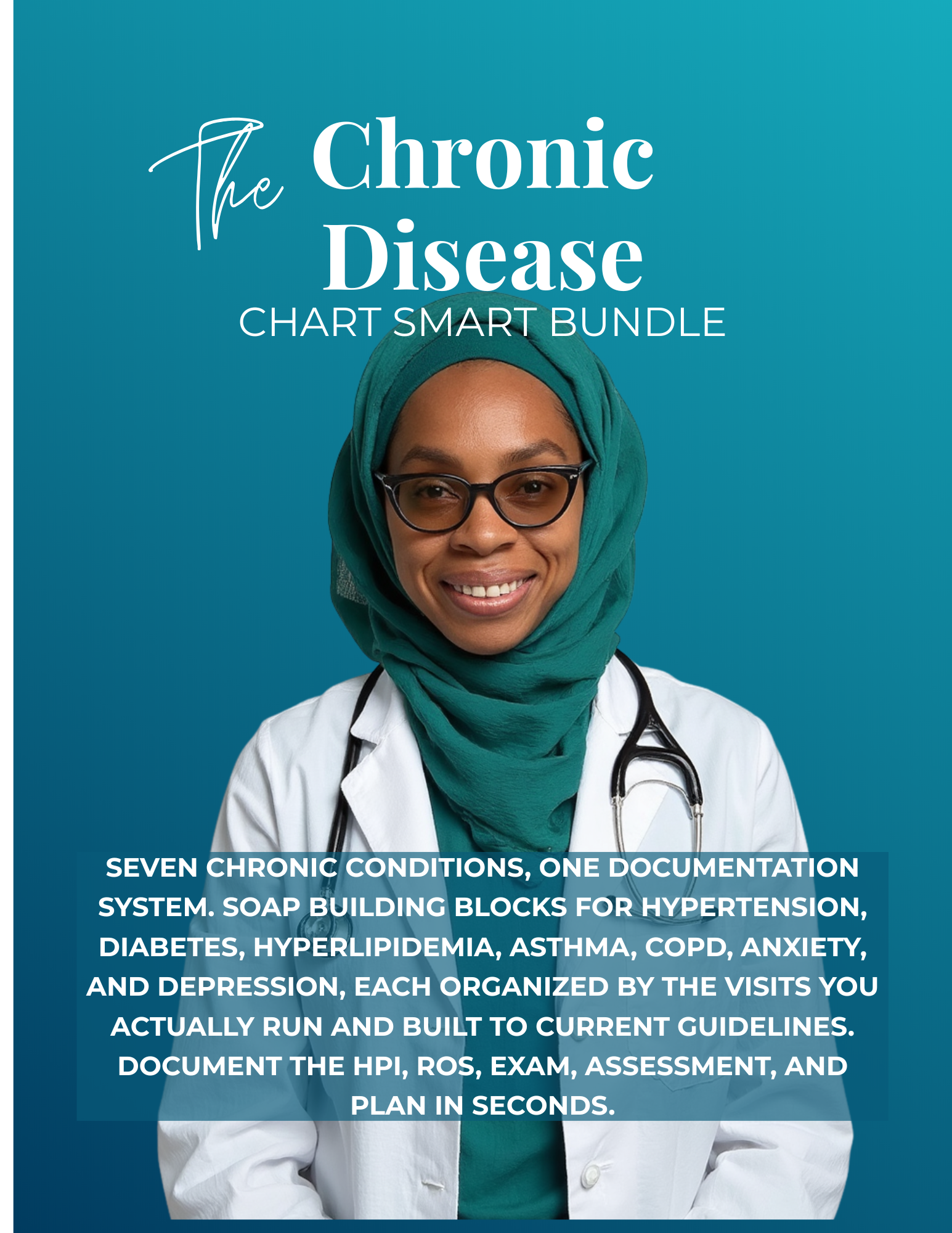
The Chronic Disease Chart Smart Kit Bundle: pre-built SOAP blocks for the seven conditions that fill your schedule, so real-time documentation becomes dropping them in and filling the detail while the patient is still in the room. Click through to see what's inside.