I Don't Do It All: The NP, Working Mother, and the Myth of Handling Everything
There is a question that shows up in every NP group, usually from someone who is one bad week away from quitting. How do you do it all?
I want to answer it plainly, because the real answer is the thing that changed how I work.
I don’t do it all. I made peace with that a long time ago.
If you are a nurse practitioner and a mother and you feel like you are failing at both, read on. Not because you need to try harder. Because the thing you have been trying to do was never actually possible, and no one said so out loud.
The work that follows you home is not proof that you are behind. It is proof that the job was built to need more hours than the scheduled week holds, and you have been covering the gap at your kitchen table after the kids go to bed.
This is a job design problem, not a character flaw.
Why does it look like everyone else is handling it?
Because the parts that make it look handled are invisible, and the parts that fall apart happen after dark where no one can see them.
The colleague who seems composed is also charting at 9 PM. Or she has a partner doing half the household. Or she pays for help you are not paying for. The comparison you are running in your head is rigged, because you are measuring your backstage against everyone else’s front of house.
No one is doing it all. They are either hiding the cost or paying to move it somewhere else.
What is actually following you home?
Not your patients. The administrative tail of the visit. The part the schedule never made room for.
Walk through a normal day and it is the same list every time:
Results to review
Portal messages
Refills
Prior authorizations
Consult reports and forms
None of it appears on your schedule. All of it is expected to get done. So when it does not fit inside the day, it moves into your evenings and weekends.
Here is the piece almost no one explains. You are an exempt salaried employee. That does not mean you owe unlimited hours. It means there is no overtime to discourage your employer from designing a day that needs more than 40 hours to finish.
The salary stays fixed. The hours expand. Your real pay per hour drops, and there is nothing built in to recover it.
That is a labor subsidy. And you are the one paying it.
If you want to see exactly where your hours are leaking, the free NP Workflow and Survival Guide breaks down the difference between a skill-gap problem and a job-design problem, so you can tell which one you are actually dealing with.
So what does “I don’t do it all” actually look like?
It looks like deciding, on purpose, what gets my hours and what does not.
At work, my job gets 40 hours. That is 32.5 hours of patient care and 7.5 hours of administrative time inside the scheduled week, and I do not work past it. My work notifications shut off when business hours end. Very few colleagues have my personal number, and the ones who do know that a work text after hours sits unread until the next business day.
I also work full time in primary care and precept NP residents and students, and all of it still stays inside business hours. Not because I am faster than you. Because the workflow is built to hold it.
At home, I gave up the fantasy of doing everything myself years ago:
The house gets cleaned twice a month.
I batch cook, I use the crockpot, I freeze ahead.
Groceries come online.
My husband does the laundry, and I stay out of how he does it.
When my kids were small, we lived near family for backup childcare. They are teenagers now and the grandparents are the ones who need closer help, so proximity still matters.
There is no doing it all. There is deciding what gets your hours.
Isn’t the real answer just better time management?
No. Efficiency helps at the margins, but you cannot out-organize a job that was designed to overflow.
Speed and effort do not fix a problem that is built into how the job is set up. If the visit volume plus the administrative tail genuinely does not fit inside the scheduled day, no system closes that gap. It only changes who absorbs it.
So separate two questions that usually get tangled together:
Is my workflow actually built for this job?
Was this job ever designed to fit inside 40 hours?
Confusing those two is how competent NPs end up blaming themselves for math that was never in their favor.
I broke the dollars and hours of that math down in Stop Working a 60-Hour Job on a 40-Hour Salary. If your effective hourly rate has quietly dropped below what you made as an RN, that article shows you the number.
Where do you actually start?
You start by making the invisible work visible, then deciding what it costs you to keep absorbing it.
Here is the sequence I would give a new NP mom who feels underwater:
Track where your after-hours time actually goes for one week. Not a guess. Write down what could not finish during visits, what inbox work had no protected time, and what tasks you took on that no one ever scheduled.
Sort each item by owner. Does this have an owner who is not you (the front desk, the MA, the schedule itself), or is it genuinely your clinical work?
Redefine “done” for the work that is yours. A defensible, compliant note is done. A perfect note rebuilt at 9 PM is not the standard. It is a subsidy.
Stop quietly absorbing the work that belongs to someone else. Route it back to the owner instead of finishing it for them at home.
Pick one workflow to simplify and hold it for two weeks. For me, one of the biggest was deciding to stop calling patients for every lab result and moving most results to the portal instead. I explained why I do that on YouTube.
Make the invisible work visible. You cannot set a boundary around something you cannot see.
What about the guilt?
The guilt is the mechanism. It is what keeps the subsidy running.
The cultural story that a good NP gives everything, and a good mother gives everything, is exactly the story that costs your employer nothing. As long as you believe staying late is what a dedicated NP does, no one above you ever has to fix the staffing or the schedule that made the late night necessary.
So it helps to know what closing the laptop at 5 actually is. An unsigned note is unbilled revenue for your employer. Finishing it on your own time is not devotion. It is accounting that happens to land on you.
And an NP running on no recovery time is running on habit instead of judgment. That is when the unusual presentation gets missed.
Finishing the work inside your scheduled business hours is a billing and a patient-safety issue, not a personal preference. Boundary-setting here is not selfishness. It is the job working the way it was supposed to.
You do not have to do it all
You need two things instead. The work has to fit inside scheduled business hours, and a workflow that keeps it there.
For most NP mothers, the single biggest piece of work that follows you home is the inbox, because it is the one part of the day no one ever put on the schedule. Keeping it inside scheduled business hours is most of the battle.
If you want the system I use to keep the inbox inside business hours, the triage, the batching, and fifty ready-to-send patient message templates that install once in any EHR, the Primary Care Inbox Bundle is built for exactly that.
You are allowed to have a workday that ends. That is not a luxury. It is the job done correctly.
Related Reading
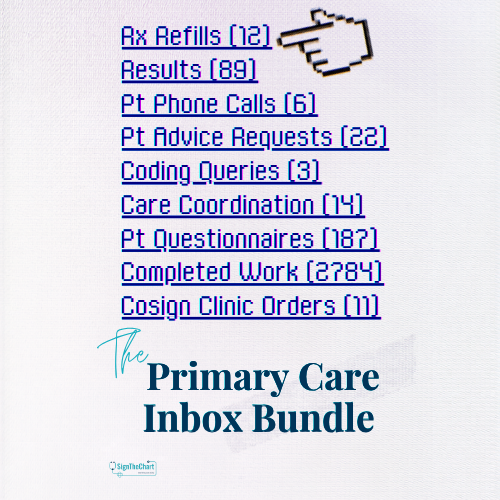
This is a real primary care inbox. Results sitting at 89. Advice requests at 22. Questionnaires at 187. None of it has a place on your schedule, and all of it is expected to get done. The Primary Care Inbox Bundle is the triage, the batching, and fifty ready-to-send message templates that keep it inside scheduled business hours.