No, I Won't Prescribe That Through the Portal
A patient messages the portal asking you to call in something for a yeast infection. Or an antibiotic for what sounds like a cold. Or a small change to a medication. You are between patients, the message is right there, and it would take ten seconds to just do it.
Don't.
That ten-second yes is how your inbox turns into a second clinic you run after hours, without overtime compensation, with your license on the line.
This post is about why new plans of care and new prescriptions do not belong in the portal, and the exact boundary, plus a script, that holds the line without making you the bad guy.
A new plan of care does not happen in the portal. It happens in a visit.
Why not just handle it through the portal? It is faster.
Because the moment you start, every symptom becomes a portal message with a full workup attached, and none of that work is on your schedule.
Once patients learn that you will prescribe by message, the door is open. Every itch, scratch, tingle, and burn arrives as a portal message expecting a decision. It piles on top of the patients in your waiting room, the notes you still owe from today, and the results already sitting in your inbox.
Here is the part that makes it a trap. None of that work has a place on the schedule, so it lands in your evenings. You are an exempt salaried employee, so there is no overtime to catch those hours. The work is real, the time is real, and you absorb it. That is a labor subsidy for your employer because they’re not paying you overtime for this, and it grows every time you say yes.
I wrote about the bigger pattern in The Chaos of the Inbox, if you want the full picture of how this builds.
Why a prescription request is actually a visit
A prescription medication requires a prescription for a reason. Someone has to evaluate the condition and decide the medication is appropriate. That someone is you, and that evaluation is a visit.
Think about what the prescription requirement is actually telling you. If Diflucan could be handed out safely without an evaluation, it would sit on the shelf next to the Monistat. It does not. The fact that it takes a prescription means a qualified person has to assess the situation and make a call.
Doing that by portal message strips the encounter of the exam, the documentation, and the billable visit. What it leaves behind is the clinical liability, which stays with you, for a decision you made off the schedule on partial information.
And it is partial. A portal message gives you a sentence or two. No exam. No vitals. Often no reconciled medication list. You would be carrying the risk for a yeast infection that is not a yeast infection, on a fraction of the picture.
The reason most NPs cave on these messages is that writing a kind, clear no five times a day is exhausting when you build it from scratch every time.
Some of these messages are asking a question that could have been answered in the room. Say It Before They Leave is free, and it gives you those words: twenty end-of-visit templates, each one text you can paste into the after-visit summary plus a line to say out loud before the patient leaves, including what the portal is for and what it is not.

Answer the Question Before It Becomes a Portal Message
20 free end-of-visit templates. Each one is a script you say before the patient leaves and text you paste into her after-visit summary, so she goes home knowing what happens next.
What do you actually say?
The response only needs to do three things. Acknowledge the concern. Name that a new symptom and a new medication have to be evaluated in a visit, so you can examine the patient and confirm the treatment is appropriate and safe. Offer to get them scheduled, with a line about when to be seen sooner if things worsen before then.
That is the whole move. Once you have wording you trust, you build it into a dot phrase so it is one click instead of a paragraph you retype all day.
The principle underneath it is simple. A new clinical decision needs a visit. A question about a plan you already made, or a result you already ordered, can be handled in writing. A request for a new prescription or a medication change sits on the visit side of that line, every time.
The portal is for messages. It is not a line for new clinical decisions.
Isn't it kinder to just help them?
It is not kinder to make a clinical decision on partial information off the schedule. The kind version and the safe version are the same version. It is the visit.
The patient who actually has a complicated infection, or something that is not an infection at all, is better served by being seen than by a guess sent through a message thread. Boundary-setting here is patient safety, not self-interest.
There is also a longer arc to watch. The favor you do today becomes the expectation tomorrow. Prescribe through the portal once and you have taught that patient, and eventually the panel, that the portal is a prescribing line. You will be unwinding that for months.
I talk about a related version of this boundary, why I do not call patients for every lab result, on YouTube.
Keep the portal a messaging tool
One clear rule on portal prescribing fixes one category of message. The inbox has a dozen more, each one capable of pulling clinical work off the schedule and into your evening.
If you want the full system for deciding what gets answered, what gets scheduled, what gets handed to staff, and what gets a written response, plus fifty templates that install once in any EHR, that is the Primary Care Inbox Bundle.
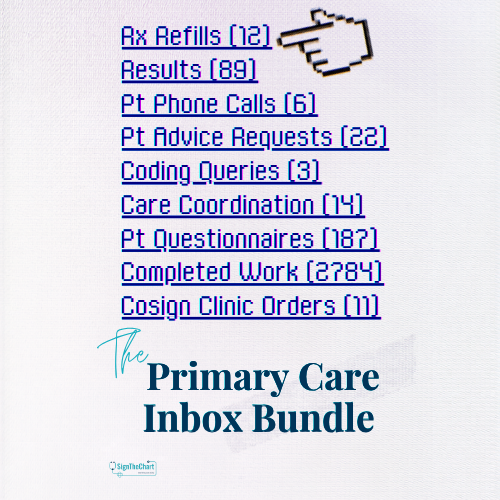
The Inbox Workflow NP School Never Taught
51 ready-to-paste message templates plus the workflow around them, for the portal messages, results, and refill requests that arrive after the visit. Built so the inbox gets handled inside the hours you are scheduled to work, not after them.
The portal is a messaging tool. It was never a second exam room. You get to keep it that way.
Related Reading
Dealing with Patients Demanding Antibiotics for a Cold: how to hold a clinical no without giving the visit away.
The NP Training Gap: why no one taught you to run an inbox, and why that is job design, not a personal failing.
Stop Working a 60-Hour Job on a 40-Hour Salary: the dollars-and-hours cost of clinical work that lands off the schedule.