Why the Same Hypertension Visit Takes 5 Minutes One Day and 25 the Next
Charting time swings from 5 minutes to 25 on the same hypertension visit. Why it happens to NPs, and why typing faster is not the fix.
You finish a hypertension follow-up in 5 minutes flat. Later that same day, another one, same diagnosis, same stable patient at goal, takes 25.
It is easy to read that as a focus problem, or a you-were-tired problem, or proof that you are just slow at charting. It is none of those.
The swing is real and it has a cause. What changes between those two visits is not your speed. It is how much of the thinking was already done before the patient sat down.
Charting speed is mostly preparation. It is almost never typing.
Why does the same hypertension visit take 5 times longer to chart some days?
Because the fast version starts with something already in place and the slow version starts from nothing. When you walk in already knowing the patient's story, the note has a shape before you type a word. When you meet the chart and the patient at the same moment, you are doing the reading, the thinking, and the writing all at once.
The variable is not discipline. It is what existed before you opened the door.
This is worth naming clearly, because most NPs I precept and advise assume the opposite. They think the colleague who finishes on time types faster or cares less. Neither is usually true.
The more efficient NP has front-loaded the work. The less efficient NP is doing the same work, just later in the encounter and under worse conditions, with a patient watching you and the schedule running.
Is charting speed really a preparation problem?
Yes, and it shows up most clearly in learners. An NP who looks slow in the room is usually not slow at documenting. She is meeting the patient’s chart for the first time while the visit is already happening, which means she is reconstructing the patient's history in real time instead of confirming a picture she already has.
I watched this land with a resident once.
We worked through one of her assigned patients together in the chart before the visit, with the patient scheduled and waiting. 7 focused minutes. At the end of it the note was not blank, the visit had a shape, and she had a clinical plan.
She walked into that room knowing the patient. She came out 22 minutes later and said, “I cannot believe how easy that was. I covered everything and I did not spend a whole hour in there.”
22 minutes, for the kind of patient who would typically cost a newer NP 3 entire appointment slots. The note was nearly complete before the patient left the room.
7 minutes in, roughly 30 minutes back on a single encounter. That is not a typing improvement. That is the same work moved earlier.
Do dot phrases already solve this?
Dot phrases are exactly the right tool. What decides whether they save you time is how complete they are. A drawer of individual snippets still leaves you deciding what goes where while the patient waits. A set built for the whole condition does not, because that decision was already made.
This distinction is worth being precise about, because "I already use dot phrases" is the most common reason an NP decides this problem is not hers.
Fragments move the typing earlier. They do not move the thinking earlier. You are still assembling the note's shape in real time, only with better raw material to assemble from.
A complete set for a condition you see every week is a different object. You open it, you confirm, you adjust what is specific to this patient. The structure arrived before the visit did.
What makes a dot phrase fast is the work that happened before you ever used it. Whatever your system calls it, SmartPhrase in Epic or the equivalent elsewhere, the speed was built in advance or it was not built at all.
Why do notes get long without getting better?
Because length and clarity are different things. A note can be thorough, wordy, and still missing the sentence that makes the plan make sense. When the reasoning stays in your head instead of on the page, the next reader cannot follow the decision, and you end up re-explaining it later.
I once gave documentation feedback to two learners whose visits I had precepted. In both cases we had worked through the clinical reasoning together during the visit. In both cases the note did not contain it.
The first note said the patient's hypertension was uncontrolled, then stated the plan, with nothing in between. What was missing was one sentence naming why it was uncontrolled.
That sentence is the bridge. Without it, the plan does not make sense to anyone who was not in the room.
Neither learner was careless. Both were competent and both had the reasoning. It just stayed in the room, as a conversation between preceptor and trainee. Wordiness does not close that gap, which is exactly why typing faster does not fix a slow charting day.
The standard I hold my own notes to is that someone who was not there, who did not see the visit, and who cannot call me should be able to act on what I wrote. If the hypertension is uncontrolled, the note should say why before it says what I did about it.
The free SOAP Note Template is a clean starting structure if your notes have drifted into long-but-unclear.
Which visits cost you the most charting time?
The predictable ones. Stable, at-goal chronic disease follow-ups are the highest-volume, lowest-variation visits in primary care, which makes them the visits you rebuild from scratch most often. Every rebuild of a visit you have documented hundreds of times is time spent re-earning something you already know.
That is the quiet cost. It is not one 25-minute note.
It is the same 25-minute note, repeated across a week of stable hypertension, diabetes, and hyperlipidemia follow-ups, none of which required fresh thinking and all of which got it anyway.
The swing has been measured, though not on us nurse practitioners. Researchers pulled a year of Epic audit-log data for 307 primary care physicians across 31 clinics, where every visit was scheduled for 30 minutes. The EHR work attached to one of those visits came to a median of 36.2 minutes. Across clinics, it ranged from 23.5 to 47.9 minutes per visit (Rotenstein et al., JAMA Network Open, 2023).
Same scheduled visit. Roughly double the documentation time. The authors found that variation both between clinics and between individuals working inside the same clinic, which is the two halves of this problem showing up in one dataset.
That study measured physicians, not NPs. Take it as the closest available picture of the work rather than a number about your day.
Meanwhile the visit that genuinely needed your attention, the newly uncontrolled patient or the complicated regimen change, got whatever minutes were left over. Usually at the end of the day, when you had the least to give it.
There is a safety return in that, and it is the argument I would make if I only got one. When the routine visit documents itself, the visit that does not fit the routine stands out instead of blending into a tired afternoon.
An example: the same visit documented two ways
The following patient is invented, not a real person.
A 62-year-old woman with hypertension comes in for a 3-month follow-up. She is at goal on an unchanged regimen. Nothing about this visit is clinically interesting, and that is the point.
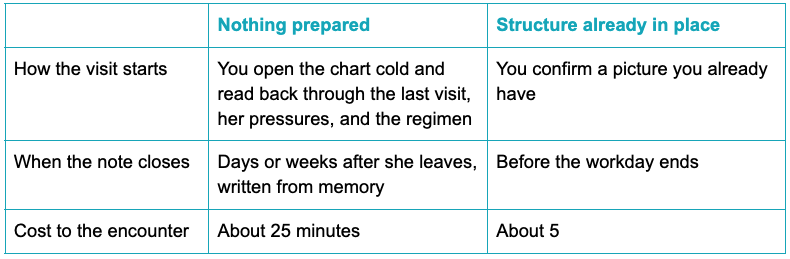
Same patient. Same medicine. Same quality of care. The difference sits entirely in when the thinking happened.
What actually changes how long charting takes?
Two things, and neither is effort. The work has to move earlier in the encounter, and the notes for your most predictable visits have to stop being rebuilt from a blank screen every time. Both are tooling problems, not character problems, which is the good news: tools can be built once and then used every day.
I want to be careful here, because this is where advice usually turns useless.
Telling you to prepare more is not help if you have 15-minute slots and no admin time protected from patients and from meetings. Telling you to build your own complete set of dot phrases is not help either, if building them is one more project competing with the notes you already owe.
The honest version is that this is a real build. It takes deliberate work up front, and it pays back every clinic day afterward. Whether you do that yourself or start from something already built is a resourcing decision, not a virtue test.
The Chronic Disease Chart Smart Kit Bundle exists so the second option is available: ready, guideline-anchored note structures for the chronic disease visits that fill a primary care schedule, so the predictable ones stop costing you the afternoon.

Chronic Disease
Chart Smart Bundle
7 Chart Smart Kits of done-for-you SOAP note templates for the chronic disease visits that come back to your schedule every few months. Save them once in any EHR that lets you create and save your own templates or dot phrases.
The stable hypertension visit is not the one that should be eating your evening. It is the most solvable visit on your schedule.
Questions NPs ask about charting time
Is it normal for charting time to vary this much on the same type of visit?
Yes, and the variation usually tracks preparation rather than effort. The same stable follow-up can take 5 minutes or 25 depending on whether a structure existed before the patient sat down. A swing that size is a tooling signal, not evidence that you are slow.
Will typing faster fix how long my notes take?
No. Typing speed has a ceiling and it is not where the minutes go. The time is spent reading the chart, reconstructing the history, and deciding what the note should say, all while the visit is happening. Moving that work earlier is what changes the total.
Do dot phrases make charting faster?
They do when they are complete for the condition. A drawer of unconnected snippets still requires you to decide what goes where under time pressure, which is the part that costs minutes. A set built for the whole visit removes that decision, because it was made before the patient arrived.
How long should a stable chronic disease follow-up note take?
There is no published standard, and a target minute count would not help you. The more useful question is whether the note closed by the end of the workdayday or lingers in a work pile for several days after the patient left. A note that travels home with you is a workflow signal, whatever the minutes on it were.
Is there research on how much time documentation actually takes?
Yes, for physicians. A 2023 JAMA Network Open study of 307 primary care physicians found a median of 36.2 minutes of EHR time per visit, with 6.2 of those minutes falling after hours. An earlier Annals of Family Medicine study found 1.4 hours a day after clinic ended. Both measured physicians.
Related Reading
Why a Good Template Outperforms Your Best Effort Every Time: why consistency beats careful reconstruction on the days the schedule falls apart.
Real-Time Documentation: The NP Skill That Eliminates After-Shift Charting: closing the note in the room instead of after the last patient.
The Chaos of the Inbox: the after-visit companion, and why that work has no time on the schedule either.