Prior Authorization: The Work Nobody Put on Your Schedule
Prior authorization work has no slot on a primary care schedule. Where the time goes, which parts need your license, and what it does to your pay.
A prior authorization is not a clinical task. It is a clerical task with clinical consequences, and it lands on the person with the least open time in the building.
You already made the decision. You know why the patient needs the medication. Now someone who has never met her needs it in writing, in their format, inside a window you did not set.
None of that was on your schedule this morning, and none of it will be on your schedule tomorrow.
You are not slow at prior authorizations. Nobody set aside time for them.
How much time do prior authorizations take?
Physicians and their staff spend an average of 13 hours a week on prior authorization, according to the American Medical Association's 2025 survey of 1,000 practicing physicians, who complete an average of 40 requests a week. That is physician data. I have not found an equivalent count of NP time in any journal or professional survey.
Those figures come from the 2025 AMA Prior Authorization Physician Survey, released in May 2026. The same survey found that 2 in 5 physicians now employ staff who work on prior authorization and nothing else.
Now ask who that person is in your clinic. If nobody holds the job, the job did not disappear. It went to whoever signs the order.
The absence of an NP count is not evidence that NPs are spared. It means nobody is counting.
Why does prior authorization work end up after hours?
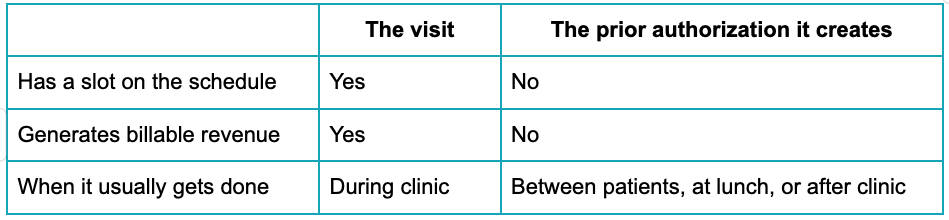
Prior authorization work ends up after hours because a primary care schedule is built from visits, and prior authorization is not a visit. The day is booked edge to edge with patients, and the forms, status checks, and resubmissions those patients generate land in whatever space is left. Most days that space is after the last patient leaves.
The visit has a time slot. The work the visit creates does not.
That gap is a feature of how the schedule was built, not a measure of how fast you are.
A 2021 JAMA Network Open study of 349 organizations using Epic found that physicians and advanced practice practitioners such as NPs and PAs in family medicine averaged 31.2 minutes a day of active EHR work after hours, in 2019 data. That study did not separate out prior authorizations, but it shows where unscheduled work goes.
Is a denial a verdict on your clinical judgment?
A prior authorization denial is usually not a verdict on your clinical judgment. A reviewer checks a request against written criteria, and most denials come back because the reasoning behind the order never reached the form. A sound decision can still fail review. That makes the denial a paperwork problem with a time cost attached.
I wrote about what the record behind a request needs to show in Prior Authorization Documentation That Gets Approved the First Time.
Every denial for missing information is the same work done twice.
The second round has no slot on the schedule either.
Which parts of prior authorization actually require your license?
Less of prior authorization requires your license than most NPs end up doing. Your clinical reasoning and your signature require you. Checking which plan the patient is on, tracking status, resending forms, and calling the pharmacy generally do not. When every piece routes to the prescriber by default, the license-level work waits behind the clerical work.
What your support staff may do depends on your state and your role, and it varies a great deal. A task a medical assistant may handle in one state belongs to a nurse in another. Check your own state's rules and your practice's policies before you change anything.
The point is not to hand off your work. It is to stop absorbing work that never needed an NP.
Otherwise the work that does need you waits until 8 PM.
In a 2025 Annals of Family Medicine study, a safety-net system of 11 primary care clinics added pharmacy technicians to medication work, and prior authorizations made up 17% of the 43,782 medication tasks they handled.
Physicians, NPs, PAs, and nurses there rated medication access as a pain point at 8.3 out of 10 before the change and 3.6 after. More than half estimated the technicians saved them at least 5 hours a month. The authors note those hours were self-reported, not measured.
I wrote about where that line between licensed and routable work sits in The Work That Doesn't Require Your License Shouldn't Consume Your Time.
Where does prior authorization work go when the NP does not do it?
Prior authorization work the NP does not do goes to someone who is already full. In my practice, prior authorizations run through nursing, so any ordering error I make becomes a nurse's work. Rushed orders do not stay with the person who rushed them. They travel to colleagues who have no spare time to absorb them.
The cost of an unfunded task does not disappear. It moves to the next person in line.
I start a lot of patients on GLP-1 medications. For a long time I ordered them by hand every time, picking the version, the dose, and the form from a crowded medication database.
The commercial plans we see most want a specific version at a specific dose in a specific form. Pick the wrong one and the prior authorization does not go through. That is my practice's experience with our plans, not formulary guidance; requirements change and vary by plan and by state.
When I got it slightly wrong, I did not absorb the mistake. A nurse did. She caught it, pended the correct order, and came to find me: "Candice, I pended the right one, can you sign it?"
Our nurses already carry a full load and they do it well. I was adding to it a few times a week with errors that were preventable. That is what finally got me to fix it.
Nothing in my workday was set aside for that repair. On a day I happened to have a few minutes, I built the order sets properly. Since then, not one nurse has come back to tell me I signed the wrong thing.
What does unscheduled prior authorization time do to your pay?
Unscheduled prior authorization time lowers your effective hourly rate, which is your salary divided by the hours you actually work, not the hours on your schedule. Primary care NPs are almost always exempt salaried employees, meaning no overtime pay starts at hour 41. Extra hours stretch the same salary across more time, and your real pay per hour drops.
The arithmetic is simple. If your salary was set for 40 scheduled hours and prior authorization work adds 3 more each week, the same salary now pays for 43. That is roughly a 7% drop in what you earn per hour, with no line on any pay stub to show it.
That is wage dilution: the salary stays the same while the hours behind it grow.
I talked through how inbox work does this to a salary in Inbox Overflow Is Eating Your Salary. The full method for putting a number on your own rate is in Know Your Number.
If you want your own numbers rather than mine, the Spillover Hours Audit is a free tool you fill in with your scheduled hours and your real ones.
It shows where the extra time lands and whether the fix is your workflow, the way the job was built, or nothing at all. Sometimes the answer is that your week is working.
Working Hard and Still Backlogged?
A free interactive tool. Enter the hours your schedule holds and the hours you actually work, and it shows where the extra time lands and whether the fix is your workflow, the way the job is set up, or nothing at all.
Does getting faster at prior authorizations solve the problem?
Getting faster at prior authorizations helps, but it is not enough on its own. Faster work shrinks each request, but the requests keep coming with no time attached to them. An NP who has fully mastered the workflow still works inside a schedule that never funded this work, so the time has to come from somewhere.
I have mastered Epic, my inbox, and my time inside the visit. The job would still take more than 40 hours if I let it.
It stays inside 40 because I hold the line every day, on how I run the workday and on what I will and will not accept.
Read that as proof the problem was never my speed. If the work still pushes past 40 for someone who has solved the workflow, the volume was never matched to the hours.
Skill shortens each request. It does not create the hour the schedule left out.
An example: one request, paid for twice
The patient and NP in this example are invented.
A 54-year-old woman with type 2 diabetes needs a medication that requires authorization. Her NP has treated her for 2 years and knows exactly what she has tried and why this is the next step.
The request goes out at 4:50 PM, between the last patient and the inbox. It comes back denied for insufficient documentation of prior therapy.
Nothing about the patient changed. The NP's knowledge lived across a dozen notes, and the first submission carried almost none of it.
The resubmission is approved.
The cost was 2 rounds of the same work, both done in time the schedule never held.
Why does the same work keep getting rebuilt from scratch?
Prior authorization work keeps getting rebuilt because nothing in the workday pays for turning a repeated task into a reusable one. The medication changes and the patient changes, but the shape of what a payer needs to see changes far less. Without a reusable starting point, every request gets written from a blank page, after hours.
The messages around a prior authorization add to the pile, and they get rebuilt from scratch too.
The Message Master Kit Bundle is a set of ready-to-paste messages for the administrative work a visit leaves behind, written for patients, insurers, and your care team. You save them once in any EHR that lets you create and save your own templates or dot phrases.

Prior Authorizations, Result Management, and More
6 Message Master Kits of ready-to-paste messages for the administrative work a visit leaves behind, written for patients, insurers, and your care team. Save them once in any EHR that lets you create and save your own templates or dot phrases.
What should you verify before you rely on any of this?
Payer criteria change, and program rules change faster than any article can follow. That is especially true for time-limited federal programs, where covered drugs, eligibility, and the submission process can be revised mid-program. Confirm requirements with the plan, and for federal programs, with the agency's current materials.
The Medicare GLP-1 pathway has its own rules and its own routing problem, which I covered in The Medicare GLP-1 Bridge: Three Reasons Prior Authorizations Get Denied.
This article reflects the research and program rules as of September 2026.
It is not a substitute for a payer's current criteria or for your state's scope-of-practice rules.
Frequently asked questions
How many hours a week do prior authorizations take?
The AMA's 2025 physician survey puts it at an average of 13 hours a week of physician and staff time combined, for about 40 requests per physician. No comparable published figure exists for NPs that I have found, so treat the AMA number as a sign of scale, not as your number. Your own count is the one that matters.
Who should handle prior authorizations in a primary care clinic?
The NP supplies the clinical reasoning and the signature. Plan checks, status tracking, resending forms, and pharmacy calls generally do not require a license, though what support staff may do varies by state and role. Check your state's rules and your practice's policies before you reassign anything.
Why do prior authorizations take so much time if the decision is already made?
Because the decision is only the start. The reasoning has to be put into a payer's format, submitted, tracked, and sometimes resubmitted, and none of those steps has a slot on a schedule built entirely from visits. The time is real, and it lands wherever the day has room.
Does prior authorization work lower an NP's pay?
It lowers your effective hourly rate. Most primary care NPs are exempt salaried employees, so extra hours earn no overtime. When prior authorization work adds 3 hours to a 40-hour week, the same salary covers 43 hours, a drop of roughly 7% in pay per hour.
Related Reading
The Work That Doesn't Require Your License Shouldn't Consume Your Time: what can route to staff, and what has to stay with you.
The Chaos of the Inbox: why the work after the visit has no time on the schedule.
The Medicare GLP-1 Bridge: Three Reasons Prior Authorizations Get Denied: the one pathway with its own rules and its own routing trap.