I was out of clinic three times in about six weeks, twice with no warning, and I came back to almost nothing. Why your everyday workflow is your real leave plan, and why it held that time.
Part 1 of 2: When your workflow holds, and when it can't.
One stretch, I was out of clinic three times in about six weeks.
First, a family situation took me out for a week with no notice. I came back to work for about two weeks, then left for a vacation that was planned and approved several months earlier.
I got sick while I was traveling, with the flu strain people were calling the "super flu" that season. I was still sick when I got home, so that was another week out with no warning.
Here's what I expected to come back to: an inbox that had exploded, a stack of unaddressed patient requests, and colleagues who'd spent weeks cleaning up after me.
That's not what happened. I came back to almost nothing.
It wasn't because I'd written a careful handoff. Twice, I had no time to prepare anything. My work was already handled before any of it started.
What makes an unplanned absence survivable isn't a handoff you build in a panic. It's finishing the work that needs your license as it arrives.
Why does taking time off feel impossible for so many NPs?
Because in most NP jobs, nobody's whole job is to provide backup coverage for the inboxes of absent colleagues. Whatever you leave unfinished either waits for you or lands on a colleague who doesn't know your patients. So many NPs come to work while sick, skip vacation althogether, or check their inbox while away. That's how the job is set up, not a flaw in you.
There's no float NP for your refill requests. Nobody is assigned to read your results the way you would. The colleague providing backup coverage while you're out is still seeing her own patients, so she can only handle what's clinically urgent or time-sensitive.
That's the only reasonable thing to expect of her. If she does more, she's done you a favor.
A clinic could make backup coverage someone's whole job, with no patients on her schedule. It could also lighten the schedules of the NPs providing backup coverage for absent colleagues, to make room for what comes up while a colleague is out. Neither of those is in your hands. What is in your hands is the workflow you run every day.
So a sick day can feel like a threat instead of a basic human need. You do the math: a day away now means a pile later.
There's guilt in it too. When you call out, you know exactly who absorbs it: the colleague down the hall whose schedule didn't change to make room for your patients.
Time away matters, though. In a 2024 national survey of US physicians, those who took more than 3 weeks of vacation a year had lower odds of burnout than those who took none. The survey was of physicians, not NPs, and it shows an association, not proof. But you need the time off you've earned.
Dreading the backlog is a reasonable response to how most NP jobs are set up.
What protects you when you have to leave with no notice?
A workday where the work that requires your license is already done. If your notes are closed, your results reviewed, and your refills handled by the end of each day, there's very little left for anyone to cover. Your everyday workflow is your leave plan. There isn't a separate one waiting in a drawer.
When I plan a vacation, I usually have weeks to get ready. In that week with the family emergency, I had no runway. I left mid-week with no prep at all, and walking out the door was nerve-racking.
It didn't matter, and that surprised even me. I'd been handling clinical work as it came in, so I didn't leave a pile of urgent decisions for people who couldn't safely make them.
Back then, I closed my notes the same day about 98 percent of the time. My colleagues weren't cleaning up after me. They were covering a desk that was already clear.
My motto is stay ready so you don't have to get ready. I learned it providing backup coverage for colleagues: when I'm watching a colleague's inbox, I work through it while keeping mine current, and that only works if mine was already in order before the extra work arrived.
Staying ready isn't heroic. It's what you do on an ordinary weekday, so you don't have to do anything special on the day everything goes wrong.
Why did my workflow hold this time?
Because I was the only medical provider out. Everyone else seeing patients was at work, so my colleagues had room to absorb my absence, and my inbox held very little that couldn't wait. In the stretch I write about in Part 2, my absence landed in a clinic that was already short, and the same workflow couldn't hold.
The two stories can look like they contradict each other. They don't.
My workflow was the same both times. What changed was everything around it.
I've watched my workflow break under short staffing more than once. Each time, the way I work stayed the same. The staffing around me is what changed, and that's what tells me the pattern is predictable.
A good workflow is built for your ordinary week, with a little room to stretch for one or two wildcards. In this instance, my absence was the only wildcard, and everyone else seeing patients was at work. In Part 2, five wildcards were dealt all at once.
Your workflow decides how much you leave behind. Staffing decides whether anyone has room to carry it.
Isn't this just "stay on top of everything"?
No. It isn't about working faster or doing more. It's about finishing the work that needs your license inside the day, and letting the rest go where it belongs: deferred on purpose, or handed to the person whose job it is. Staying current is not the same as doing everything yourself.
Most of what lands in your inbox is important but not urgent. A good share of it doesn't need your license at all: a form someone else can start, a scheduling request, a question about a referral's status.
Before I touch a task, I decide what it needs. Does it need my clinical judgment now, my signature later, or someone else entirely?
The things that don't need me get deferred or handed off on purpose, not by accident.
On purpose means the task has a time and a place: a slot in my administrative time, or a note to the person who will pick it up. By accident means it's sitting in my inbox with no plan, waiting to surprise whoever covers me. I wrote more about which work belongs to you in The Work That Doesn't Require Your License Shouldn't Consume Your Time.
The skill isn't speed. It's sorting.
What if you can't get current inside your scheduled hours?
Then something isn't fitting, and the first step is finding out what. Your in-visit charting may be fine while your administrative workflow needs work, or the reverse, or both. Or the job may hold more work than its scheduled hours. Each one has a different fix, and effort alone fixes none of them.
This is the honest caveat. Finishing work as it arrives only helps if the day's work can actually fit inside the day.
If you're current only because you put in extra two hours every evening, that isn't a win. Your salary is covering more hours than it was meant to, which lowers your effective hourly rate: what you actually earn for each hour you work.
The fix isn't more discipline. It's finding out which problem you have. A workflow can be built. A job that holds more work than its hours is a design problem, and I make that case in Stop Working a 60-Hour Job on a 40-Hour Salary.
If staying current costs you every evening, something doesn't fit, and it isn't your effort alone.
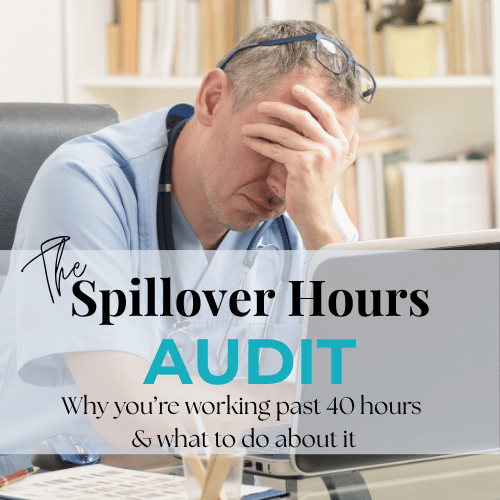
Find out which one you're dealing with
The Spillover Hours Audit is a free interactive tool. It shows you where your extra hours go, and whether the fix is your own workflow, the way the job is set up, or nothing at all, because one of its readings tells you your week is working.
How do you build the habit before you need it?
Decide a few things in advance, on an ordinary day. The goal isn't an empty inbox. It's that nothing urgent that needs your license is left undone when you log off, and anything still waiting has a clear owner, so it can be found and handled without you in the room.
You don't build this the week you get sick. You build it on the days when nothing is going wrong, because those are the only days you have time to.
It doesn't take talent. It takes deciding what "done" means and holding to it.
For me, done for the day means my visit notes are closed, my results are reviewed, and my refills are handled. Done for the week means no patient phone call or portal message sits unaddressed for more than 2 business days.
Part of what makes that work happens in the visit. I tell patients how their results will reach them: a phone call for urgent abnormal results, and a portal message for normal results and non-urgent abnormal ones. If they're not on the portal, they can sign up or make an appointment to go over their results.
I also tell them that phone calls and portal messages are the slowest way to reach me. It takes me about 2 business days to respond, and nursing triages those messages first, so something sent today may not reach me for several days.
So anything medically urgent belongs in emergency care, a walk-in visit, or a scheduled appointment, not the portal or the phone. A walk-in or an appointment is the best way to reach me, because it guarantees 15 minutes of my undivided attention. A message can cycle through several departments before anyone addresses it.
The NP who can step away at any moment isn't the most self-sacrificing one. She's the one who never let the work pile up.
I talk about why inbox work can feel endless in this short video.
The habits that keep work out of your evenings are the same ones that leave little for your backup coverage to handle.

For the messages a visit leaves behind
The Message Master Kit Bundle gives you 6 Message Master Kits of ready-to-paste messages for the administrative work a visit leaves behind, written for patients, insurers, and your care team. You save them once in any EHR that lets you create and save your own templates or dot phrases.
What did staying ready buy me?
A clean return and a real break. I didn't come back to a backlog or to colleagues who felt abandoned. It still took about two weeks to fully catch up on what I'd missed, which is normal. What I didn't have to do was dig out of a hole I'd dug before I left.
I was able to fully disconnect during a hard stretch in my personal life, because I knew the major clinical work was done and I trusted the colleagues providing my backup coverage.
Having my clinic work handled is what let me be fully present at home, in a run of weeks when my family needed me there.
We all have human things happen to us. You can't schedule them. You can build a workday that doesn't collapse when one arrives.
Staying ready doesn't make you shortage-proof, though. In Part 2, Working Short-Staffed Broke My Charting Workflow, I write about the time I left with an empty inbox and came back to a backlog that took 8 weeks to climb out of.
A workweek that ends is what makes you safe to step away from, on the days you choose and the days you don't.
FAQ
How do I call out sick as an NP without falling behind?
Mostly by what you did before you got sick. If your notes, results, and refills are handled each day, there's little left for the colleague providing your backup coverage. Call out, expect her to handle only what's urgent or time-sensitive, and expect a few days of catching up when you return. That's normal, not a failure.
Should NPs check their inbox on vacation?
Ideally, no. If your work was current when you left and a colleague is providing backup coverage for what's urgent, the rest can wait for you. If nobody provides backup coverage, so you feel you have to check, that's how the job is set up. Ask your clinic who covers your inbox while you're away.
Is it normal to need time to catch up after time off?
Yes. Even when I came back to almost nothing, it took me about two weeks to fully catch up on what I'd missed: results that came back while I was away, patients who'd been seen by someone else, plans that had moved. Catching up is normal. Digging out of a backlog you left behind is different.
What if I can't keep my work current even when I'm not out?
Start by finding out why. Your in-visit charting may be solid while your administrative workflow needs work, or the reverse, or both. Or the job may hold more work than its scheduled hours. Each has a different fix. The Spillover Hours Audit can show you which one you're dealing with before you start changing things.
Related Reading
The Work That Doesn't Require Your License Shouldn't Consume Your Time: which work belongs to you and which belongs to your team.
Stop the Guilt: Leaving on Time Is Part of the Job: why leaving when your day ends is part of the job, not a lack of commitment.
I Don't Do It All: The NP, Working Mother, and the Myth of Handling Everything: what it takes to be fully present at home when the clinic work is handled.