Stop the Guilt: Leaving on Time Is Part of the Job
NP work-life balance can feel like a lapse in dedication. The guilt is learned, it points at the wrong cause, and leaving on time is part of safe care.
Last Updated: 10/18/2026
The last patient left at 4:40, and you were still at your desk at 6:30. On Saturday you opened the laptop before anyone else in the house was awake, cleared what you could of the inbox, and closed it again feeling something closer to relief than resentment.
That relief says a good deal about how the job has taught you to measure yourself. Somewhere along the way, finishing the day's work after hours began to feel like conscientiousness, and leaving when the schedule ends began to feel like something you would have to explain. The guilt has a history, though, and once you can see where it comes from, it stops looking like a verdict on your commitment.
Why does leaving on time feel wrong for NPs?
Because most NPs formed their professional habits in a role where the shift ended with a handoff. As an RN, unfinished work went to the next nurse at report. As an NP, nobody takes your panel at 5, so whatever the day did not finish waits for you, and staying late starts to feel like the responsible choice.
Medicine and nursing both reward visible sacrifice. The colleague who stays latest is called dedicated, and the one who leaves when the schedule ends can find herself wondering how it looks. Those messages are rarely spoken outright, which is what makes them so hard to argue with.
What changed when you became an NP was not your work ethic but where the unfinished work goes. The discomfort you feel at 5 is a reasonable response to a day that left work behind. It attaches itself to the wrong conclusion, that the problem is you leaving, when the problem is a day that never held the work in the first place.
The guilt is aimed at the person leaving, but it belongs to the day that could not hold the work.
Why does NP work run past the end of the day?
Because most primary care schedules are built around the visits, not the work the visits create. Refills, results, messages, and the notes themselves still need time after the patient leaves. When the template books every slot, that work has only one place to go: the hours after clinic, at no added cost to your employer.
The arrangement is easy to miss from inside the day. A practice is paid when a note is signed and a claim goes out, not when the patient is seen, so every unsigned chart is revenue that has not yet arrived. A schedule that fills every hour with visits and sets aside no time for documentation therefore depends on NPs finishing that documentation outside their scheduled hours to turn visits into billable claims.
Most primary care NPs are exempt salaried employees, which means the salary covers the role rather than a set number of hours, and no overtime begins at hour 41. That classification removes the cost that would otherwise give an employer a reason to rethink a day that cannot be finished on schedule. The claims still go out, and the hours it took to send them appear on no ledger but yours.
Administrative Chaos maps the work each visit leaves behind, and Stop Working a 60-Hour Job on a 40-Hour Salary follows that design through to what it does to your pay.
A schedule that books only the visits has already decided when the rest of the work will happen.
Does working longer hours make you a better NP?
No. Long hours are not a measure of care quality, and the evidence points the other way. In a 2023 study of primary care NPs, practices with higher NP burnout had more emergency visits and hospitalizations among older patients with chronic conditions. Exhaustion is a risk to patients, not proof of commitment to them.
The study, published in INQUIRY by Poghosyan and colleagues, surveyed 1,244 primary care NPs in 6 states and linked their answers to Medicare claims for more than 467,000 patients. About 1 in 4 of the NPs reported burnout. The associations were small, as the authors acknowledge, but they ran in a consistent direction and were strongest for conditions that good primary care is supposed to keep out of the hospital.
Equally telling is where the authors placed the cause. They described burnout as a product of the work environment, including inadequate support and limited autonomy, and recommended changing those conditions instead of asking individual NPs to try harder. That runs directly against what the guilt tells you. An NP who leaves on time with her work closed is not choosing herself over her patients; she is protecting the judgment they will rely on the next morning.
Rest is not a reward for finishing the work. It is part of doing the work well.
What does after-hours work actually cost you?
It costs you pay, and it costs you time you cannot get back. Every hour past your schedule spreads the same salary across more hours, so your real hourly rate falls. And those hours come from somewhere specific: the school pickup, a parent's appointment, the evening someone at home needed you there.
The pay side is arithmetic you can run with your own numbers, and Know Your Number walks you through it. The time side resists a figure, and it is the part the guilt works hardest to obscure, because it frames every hour given to the job as virtue and every hour held back as a choice in need of a defense.
A job built with no margin for ordinary human variation is not a demanding job. It is a staffing problem. People get sick, people have parents, and a schedule that only works if nobody in it ever needs time for a life was not built for people. When it breaks, the guilt lands on the NP, though it belongs to how the job was set up.
A schedule with no room for a life was not built for the people working it.
I felt that most sharply when my father needed a cardiac procedure, which put me on the other side of the exam room in a role reversal I was not ready for. I translated what his doctor was saying so that he could understand it well enough to decide whether to go forward. I went to his appointments before, during, and after the procedure, made the pharmacy runs, and took calls from his care team during my own workday.
And I had my own patients who were angry that their visits had been rescheduled because of my family life. What kind of person would I be if I left my father to deal with that by himself so that I could take care of other people's parents?
Is setting boundaries enough to fix NP work-life balance?
No. A boundary without a system leaves you choosing between leaving on time with work still open and staying until it is done. Leaving on time holds only when two things are true: the day is built with time for the work it creates, and your own workflow closes that work inside it.
Those two conditions are not equally yours. You rarely control the scheduling template or the support staffing, and together they set how much the day can hold. You do control how your notes get built, how the inbox gets handled, and what you will and will not stop a visit for, and those decide how much of that capacity you actually use. I talk through why the limits you set matter as much as the workload itself in Your Workload Isn't the Problem, Your Limits Are.
The distinction matters because the fixes run in opposite directions. If the day cannot hold the work however well you run it, more effort only hides the gap, and the honest response is a conversation about how the job is set up. If the day could hold it and the work still runs long, the answer is a better system, one you can build in the job you already have. The Lie of the Default EHR and The Chaos of the Inbox cover the two places that work most often leaks.
IS IT THE JOB, OR THE WORKFLOW?
The Spillover Hours Audit is a free tool you fill in with your own week. It shows where the time past your schedule goes and whether the fix is your workflow, the way the job is set up, or nothing at all, because your week may already work.
A boundary holds only when the day was built to let it.
What does leaving on time look like once the work fits?
It looks ordinary. Notes close the same day, the inbox is handled inside the hours you are scheduled, and nothing is waiting on Saturday morning, because there is no reason to open the laptop. Leaving at the end of the schedule becomes routine, not a decision you have to justify to yourself.
For most NPs, the part of the day that keeps this from happening is the inbox, because it keeps filling after the last patient leaves and rarely has a slot of its own. When the messages that arrive every day already have a place in the schedule and words ready for them, the work that used to follow you home gets done inside the day that created it.
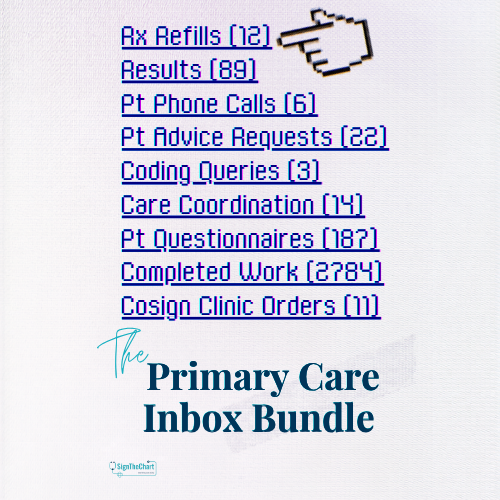
GIVE THE INBOX A PLACE INSIDE THE DAY
The Primary Care Inbox Bundle gives you ready-to-paste message templates and the workflow around them, for the portal messages, results, and refill requests that arrive after the visit. It is built so the inbox gets handled inside the hours you are scheduled to work, not after them.
None of this requires a new job. Most NPs are staying where they are, often for reasons that make complete sense, and the point of getting the work to fit is that the rest of your week gets you at full capacity whether or not you ever leave. I Don't Do It All describes what that looks like in a household that is already carrying a lot.
Leaving on time is not a statement about your commitment. It is what a day that fits looks like.
Frequently asked questions about NP work-life balance
Is it unprofessional for an NP to leave on time?
No. Leaving at the end of your scheduled hours with your notes closed and urgent work handled is professional practice. The expectation that dedication shows up as extra hours is cultural, not clinical, and research on primary care NPs links burnout, not reasonable hours, to worse outcomes for patients.
Do nurse practitioners get paid overtime?
Usually not. Most primary care NPs are classified as exempt salaried employees, so the salary covers the role rather than a set number of hours, and overtime pay does not apply. Some roles are hourly or paid per visit. Check your own offer or contract, and treat this as general education, not legal advice.
Why is my inbox still full after clinic?
Because messages, results, and refill requests arrive all day, and many schedules set aside little or no time to handle them. The inbox fills fastest during the hours you are seeing patients, so without protected time for it on the schedule, it waits until the last visit ends.
Is NP burnout linked to patient outcomes?
A 2023 study of 1,244 primary care NPs found that practices with higher NP burnout had more emergency visits and hospitalizations among chronically ill Medicare patients. The effects were small, and the authors attributed burnout mainly to the work environment and recommended changing working conditions, not individual NPs.
Related Reading
I Don't Do It All: The NP, Working Mother, and the Myth of Handling Everything: what keeping the work inside the day makes possible at home.
Stop Working a 60-Hour Job on a 40-Hour Salary: why the hours past your schedule cost you, and why the job is built that way.
Know Your Number: The Hourly Rate to Set Before You Sign: how to work out what your salary really pays per hour.