I left for vacation with an empty inbox and came back to a backlog that took 8 weeks to clear. Why a good charting system breaks when the clinic is short-staffed, and what you can control while you dig out.
I'm proud of how I manage my workload. I chart during the visit, I close most of my notes the same day, and my inbox usually holds nothing but new work.
So when I left for vacation, my inbox was empty.
It took me 2 months to climb out of the mayhem that awaited me when I returned.
In Part 1, I wrote about a stretch when I was out three times in about six weeks and came back to almost no extra work. Same workflow both times. What was different was everything happening around it.
If you've ever come back to a pile like that and blamed yourself, I want to walk you through how mine happened. The reason probably isn't you.
A good workflow is built for your ordinary week, with a little room to stretch for one or two wildcards.
Why does a good charting system fall apart when you're short-staffed?
Because it's built for the everyday version of your job. It can stretch for one or two wildcards. When several are dealt at once, like absences, teaching, and illness, no workflow holds, and the gap isn't in your habits. Mine broke under 5 wildcards in a row.
Here's what landed on me, in the order it arrived.
While I was away, 3 colleagues provided backup coverage for my patients and both of my inboxes, electronic and paper. Their schedules were not adjusted to make room for the fact that my work was added to theirs.
The day I came back, another colleague left for vacation. I became one of the NPs providing backup coverage for the vacationing colleague’s inbox, on top of my backlog and my regular day.
A third colleague was away for continuing education. That left 2 of us seeing patients. Every walk-in, every phone call, every portal message, and every interruption that needed a medical provider went to the two of us.
The interruptions cost more than the visits did. When a question comes in about an absent colleague's patient, I have to get oriented to someone I've never met before I can answer. Each one breaks my focus, and it takes time to find my place in my own work again.
Normally I can say no to work that doesn't need my license. But when everyone is stretched that thin, I can't. So I picked up tasks I would usually hand off, and the work only I can do got pushed later.
We were both precepting, too: a medical student and a new cohort of NP residents. Our patient volume stays the same when we teach, so the teaching has to fit inside a full clinical day.
Then I got sick and was out for several days. I didn't log in while I was sick, so that absence built its own backlog on top of the one I was still working through.
No workflow system is built to hold all of that at once, and none should have to.
What happens to your inbox when your backup coverage is still seeing patients?
They triage it. They handle what's clinically urgent or time-sensitive and leave the rest for you, because nothing came off their schedules to let them do more. That's the only reasonable thing to expect of them. If they do more, they've done you a favor.
My colleagues did exactly what I would have done. They handled the refills, the critical results, and the letters and forms with deadlines.
Everything else waited for me, because it was mine to do.
My results come straight to me, with nobody in between, and that's how it should be. The flip side is that when I'm away, they wait in my inbox until I'm back.
I talk through what the inbox really is, and what it costs you, in this video: Inbox Overflow Is Eating Your Salary.
When backup coverage means a second inbox on a full schedule, the urgent work gets done and the rest waits for you.
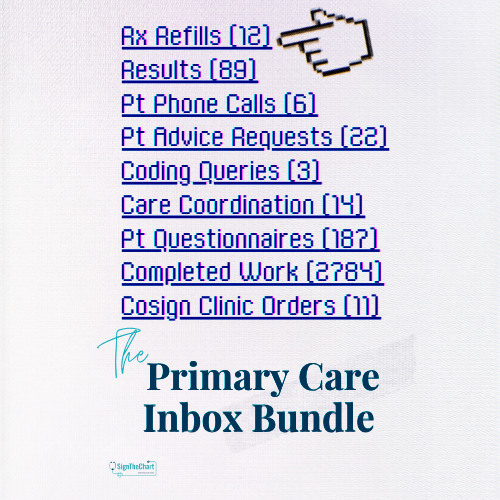
For the inbox you own and the one you're covering
The Primary Care Inbox Bundle gives you ready-to-paste templates for the portal messages, results, and refill requests that arrive after the visit, plus the workflow around them. You set it up once in any EHR that lets you save your own templates or dot phrases.
Could any of this have been planned for?
Most of it. Vacation and continuing education are requested and approved in advance, and trainees arrive on an academic calendar. Only the illnesses were truly unexpected, and even sick time is a benefit the organization knows people will use. What most clinics don't have is a plan for covering approved time off.
I want to be fair here. I still work at this clinic, and I'm not writing this because I'm unhappy there.
My job is better built than many. I have 7.5 hours of administrative time every week, protected from patients and from meetings. When everyone is at work, my system holds. No job is perfect, and there are far worse job designs out there.
What I'm describing is a gap I see in a lot of clinics, and mine has it too.
Nobody is at fault for getting sick. I got sick, and a colleague got sick during that stretch too. It’s difficult, though not impossible, schedule around that.
This also wasn't the first time. Before this, I lived through a different stretch when most of us seeing patients were out at once: one pulled away by leadership duties, one on planned medical leave, and one out unexpectedly. Again, I was 1 of 2 providers on-site and it took me 3 weeks to dig out of the backlog that one caused.
Two stretches, two different mixes of absences, the same result. That's what tells me this is a pattern, and a pattern can be planned for.
But most of the rest was on the calendar ahead of time. We request vacation and continuing education months in advance, and someone approves it. The organization grants that time andk it knows we'll use it.
What's usually missing is someone to absorb the gap. A clinic could make backup coverage someone's whole job, with no patients on her schedule. It could also lighten the schedules of the NPs providing backup coverage, to make room for what comes up while a colleague is out.
Neither of those is in the hands of the NP doing the work. What is in her hands is the workflow she runs every day.
Without that, the shortage gets treated like a car accident: something nobody could have seen coming. The people who happen to be in the building improvise a response, on top of jobs they're already fully responsible for.
Approved time off is a staffing pattern you can see coming. It isn't an act of God.
Why do so many NPs skip vacation or work while they're off?
Because without backup coverage, time off doesn't make the work go away. It waits for you. So many NPs don't use the paid time off they've earned, or they keep working their inbox while they're away, because coming back to a mountain of work feels worse than not leaving. That's the cost of a job that doesn't plan for absences.
I understand the math. If a week away means weeks of digging out, the vacation starts to look like it costs more than it gives.
But the time off is part of what you were offered. When you skip it or work through it, your salary covers more hours than it was meant to, which lowers your effective hourly rate: what you actually earn for each hour you work. And the gap in coverage stays invisible, because you filled it yourself.
Research on physicians points the same way. In a national survey of more than 3,000 US physicians, published in JAMA Network Open in January 2024, about 70 percent did some work on a typical vacation day, often patient calls and EHR inbox messages. Only about half had someone fully covering their inbox while they were away.
The physicians who did have full inbox coverage had lower odds of burnout than those who didn't. So did those who took more than 3 weeks of vacation a year, compared with those who took none.
The study surveyed physicians, not NPs, and it shows an association, not proof that coverage prevents burnout. But the inbox works the same way for us, and the pattern will sound familiar.
Inbox coverage while you're away isn't a perk. It's what makes the time off real.
What do I mean by job design?
Job design is what an organization puts in place so any staff member can do the everyday work of the job safely. That means safe for patients, protective of your license, and lower in liability for everyone. It's the staffing, the schedule, the support, and the coverage, all decided before you walk in the door.
I've believed for a long time that job design can make or break a person in a role. It shapes how well someone does there and how long they last.
You can be excellent at your work and still not have what you need to finish it inside your scheduled hours. You can't outwork that from your own exam room.
The flip side is good news. When the design is sound, ordinary workflow habits are good enough, because the design carries most of the weight.
An efficient NP with a good workflow can still crack under a job that wasn't built for the week she's having.
Find out where your extra hours are coming from
The Spillover Hours Audit is a free interactive tool. It shows you where your extra hours go, and whether the fix is your own workflow, the way the job is set up, or nothing at all, because one of its readings tells you your week is working.
What does precepting cost when your schedule doesn't change?
It drains real time out of a day that has none to spare. With a brand-new trainee, you explain your thinking, answer questions, and review their work, all during a live clinical session. If your patient volume stays the same, that time comes out of the only flexible things left: your notes and your inbox.
I like precepting, and I do it on purpose.
Where I work, the patient schedule stays the same when we have trainees, and that's common in a lot of places. So the teaching gets squeezed into the same day as the full patient load.
That math barely works when everything else is normal. It stops working when two people are running the clinic.
Teaching is real work, and a schedule that doesn't show it moves that work somewhere else.
How long does it take to dig out of a charting backlog?
Weeks, not days. Mine took 8, because the shortage kept going while I was trying to recover, so new work kept arriving while I worked down the old. The order I did things in mattered more than how fast I went. If you're weeks in and not done, that tells you nothing about your skill.
I cleared it without working off the clock. All of it got done inside my scheduled hours.
Two rules carried me through.
First, keep current work current. If today's notes and today's results slide, you're not recovering. You're just changing which pile is the worst.
Second, decide what gets your attention by clinical risk, not by how long it has been sitting there.
My paper stack is a good example. Paper results aren't automatically lower risk. When I go through that stack, I pull out the things I know can't wait first: cancer screening results, the patients I already know are high acuity, and consult reports from specialties like cardiology or nephrology.
It's an informal system, and it works because I know my patients. I remember who I referred and why.
The triage happens inside the pile, not to the pile.
What can you control when the shortage is out of your hands?
You own your workflow system. You control how you run a visit, when you write your notes, and how you sort tasks as they arrive. You don't control how many people are on the schedule, whether it flexes when someone is out, or who provides backup coverage. Knowing which is which keeps your effort where it works.
When you've done your part and the work still won't fit inside the day, you've hit the limits of the job, not your own.
Naming that doesn't fix the staffing. It does stop you from tearing apart a workflow system that was working fine.
Once my backlog was gone, my inbox went back to new work only, and it fit inside my 7.5 hours of administrative time again.
Build your workflow system anyway. You can't build one in the middle of a crisis, and when the next one comes, you only get to use what you already have.
Your workflow system won't stop the next shortage. It decides how fast you get back.
FAQ
Is it my fault if I come back from vacation to a charting backlog?
No. If your colleagues providing your backup coverage were also seeing their own patients, they could only handle what was clinically urgent or time-sensitive. Everything else waits for you. That's what backup coverage looks like when nothing comes off anyone's schedule to accommodate the need to provide backup coverage, and it happens to NPs with excellent workflow systems.
Why do I fall behind on charting every time a colleague is out?
Because their work lands on the people still there, and your schedule usually doesn't change to make room. You absorb their interruptions, their inbox, and their walk-ins on top of your own patients. A good workflow system can stretch for that once in a while. It can't absorb it every time someone is out.
What should a clinic do when NPs are out on approved time off?
Plan for it, since the clinic approved it in advance. A clinic can lighten the schedules of the NPs who are providing backup coverage for the absent colleague, or give someone without a patient schedule the job of watching the inbox for whoever is out. Both can be set up before the gap appears.
How do I stop charting at home after a backlog?
Keep today's work current, clear the backlog by clinical risk instead of by how old the task is, then go back to closing notes during the visit and handling your inbox in your scheduled administrative time. If the work still doesn't fit once staffing is normal, find out why: your in-visit charting, your administrative workflow, both, or the way the job is set up.
Related Reading
The Work That Doesn't Require Your License Shouldn't Consume Your Time: what happens to the work only you can do when everything else lands on you first.
Administrative Chaos: The Invisible Work That Steals Your Nights and Weekends: what after-hours administrative work actually costs you.
Why the Same Hypertension Visit Takes 5 Minutes One Day and 25 the Next: why your own timing swings so much on a day the schedule is under strain.