

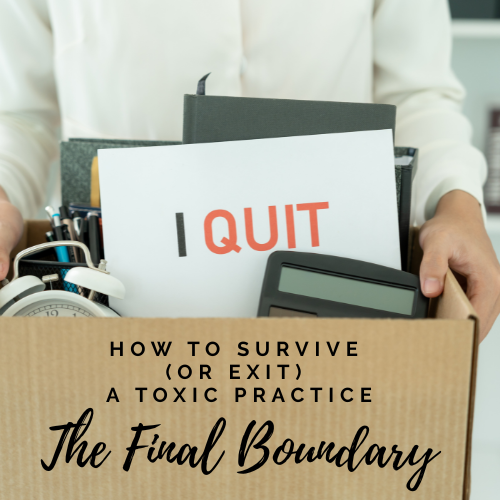
🛡️ Beyond Burnout: How to Leave a Toxic Practice (or Survive it) with Your Professional Identity Intact
The first three parts of this series covered what to do when you inherit an unsafe panel, what happens when you refuse to continue it, and why the problem is organizational rather than personal. This part is about the decision that follows all of that: whether to stay in the environment that produced it.
That decision is not simple, and it is not only emotional. It is a structural one. The question is whether the organization is capable of change and at what cost you are willing to wait for it.
I can tell you from my own situation that the institution eventually did change. New policies, evidence-based guidelines, a formal meeting with pharmacy, behavioral health, and primary care leadership. By the time that meeting happened, I was riding out my notice. The change came. It came too late for me to benefit from it, and the cost of staying long enough to see it was more than I had left to give.
That is not a cautionary tale against staying. It is an honest account of what staying through structural change can require. Know what you are deciding before you decide it.
Unsafe Prescribing is a System Problem, (Not Just a Provider Problem)
Part 3 of 4: Why Individual Refusal Is Not Enough
Parts 1 and 2 of this series covered what to do when you inherit an unsafe prescribing panel and what to expect when you refuse to continue it. This article is about the question underneath both of those: why does this situation exist at all, and what does it actually take to change it?
The answer is not a better-trained provider. The answer is organizational accountability. And the story of how that accountability finally arrived in my situation is not a satisfying one.

When Safe Practice Makes You the "Difficult" Provider
When you draw a line and refuse to continue unsafe prescribing, you are doing the right thing. What happens next is that you become the least popular person in the building.
Patients who were trained by the previous provider to expect easy refills will be angry. Leadership, which quietly tolerated the risk for however long this was going on, will be annoyed that you are creating disruption. Colleagues will respond in ways that have more to do with their own practices and their own discomfort than with anything you are actually doing wrong. And people who cannot prescribe at all will tell you what you should be prescribing.
This is not a clinical problem. It is a cultural one. Here is how to hold the line through it.
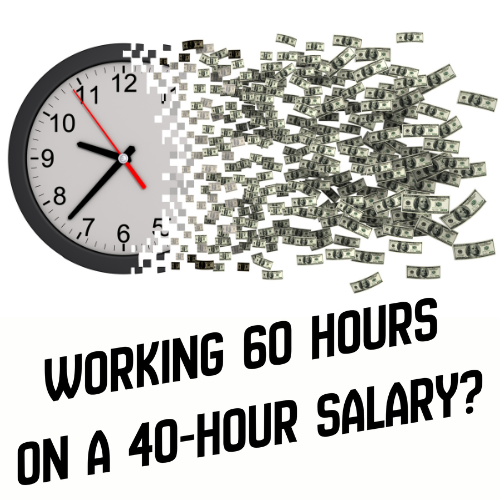
Stop Working a 60-Hour Job on a 40-Hour Salary
You didn’t invest in years of school just to give away 20 hours of free labor every week.
Yet many nurse practitioners are functionally working a 60-hour job on a 40-hour salary.
This is not a time management issue.
It is a structural design issue.
And if it is not addressed clearly, it becomes a nurse practitioner burnout cycle that feels personal — even though it isn’t.
Let’s name what is actually happening.

Job Hunting for PCPs: 8 Warning Signs You Can’t Ignore
Finding the right job as a primary care provider is not primarily about salary. It is about whether the role is structurally designed to be sustainable or structurally designed to extract unpaid labor.
Every NP job has challenges. That is the nature of primary care. But some jobs are built on a model that depends on your willingness to absorb work outside your compensated hours. The interview process is where you see that model, if you know what to look for.